So I was teaching a class last week, and had about 107 people in there. And I ask them this simple question:
“How many of you know that the option model expects stocks to go up?”
Maybe five hands go up. Maybe.
107 people trading options and almost nobody understands the basic assumption baked into every single price they’re looking at.
You guys think puts and calls are the same thing, don’t you? Like they’re just mirror images of each other?
Wrong.
The Thing Nobody Tells You About Black-Scholes
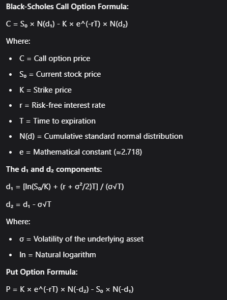
Here’s what I learned in 15, 16 years on the floor — the Black-Scholes model has a built-in bias. It literally assumes stocks go up over time.
Why? Dividends. The model expects companies to pay you for owning their stock. That’s not some opinion, that’s the math.
And here’s the part that’s gonna blow your mind… “calls are worth more than puts the farther out in time you go the same distance from the money.”
You heard that right. Take a 10-point out-of-the-money call and a 10-point out-of-the-money put. Six months out? Call’s worth more. A year out? Way more.
This isn’t some market quirk. This is mathematical reality built into every option price you see.
Why Your Put Buying Strategy Is Fighting Uphill
Every time you buy puts expecting the market to crash, you’re betting against a model that fundamentally believes stocks should rise. The pricing already assumes you’re probably wrong.
Think about it — if you’re trading options and you don’t know this, what else don’t you know?
The Distribution Game You’re Not Playing
See, most people don’t get this. Stocks trade in what we call a log normal distribution. Fancy talk, but it just means stocks go up because companies pay dividends and grow.
Volatility? That’s different. Volatility is mean reverting. It spikes, comes back down. Does nothing for long periods.
“VIX will not change until there is a reason for it to change.”
That’s what I did every day for 15, 16 years as a market maker. Did I adjust volatilities in my products from today to tomorrow? No. Only when I had to.
The liquidity providers will not change implied volatility until they have to.
Where This Gets Interesting
Remember last week when everyone’s freaking out about Israel and Iran? VIX spikes to the mid-20s and everyone thinks the world’s ending?
I’m selling volatility calls on Friday. Not because I’m some genius, but because I understand that volatility spikes need reasons to persist. And geopolitical fear? Usually doesn’t last.
By Monday morning, what happened? VIX drops back down, oil retreats, Dow rallies 300 points.
The thing is, once they decide to go into battle, that tends to be kind of the bottom of the market and the top of vol. That’s just how modern warfare works now.
The Tools They Don’t Want You To Have
You know what’s crazy? The spreadsheet I’m using to teach this stuff? It’s basically the same tool I had as a market maker at the turn of the millennium.
Only difference is mine was connected to the institutional order flow. But the math? The math is the math.
If you want to trade options and be somewhat serious about it, you need to understand these assumptions. Most retail traders are flying blind.
What You Do Now
Start thinking like the model thinks. When you’re buying six-month puts, you’re fighting an uphill battle. The pricing already expects stocks to be higher.
When volatility spikes without persistent fundamental reasons, it’s probably going back down.
And when 99% of options traders don’t understand the basic assumptions in their pricing models… well, that’s where the opportunities are.
Look, I’m not saying don’t buy puts. I’m saying understand what you’re up against when you do.
The Middle East thing will resolve or escalate. But these mathematical realities? They’re not going anywhere.
Time to start playing the same game as the people setting the prices.
Andrew “Knows The Basics” Giovinazzi
P.S. Alright, so while I’m teaching you guys about how option models have been screwing retail traders for decades, there’s something else happening right now.
This Israel-Iran thing that dropped the market? Hans Albrecht is telling me it’s creating this perfect setup for his AI plays.
He’s got this indicator — and he says we’re about 1% away from his green light number. Should hit by Tuesday.
Look, Hans found these three AI companies trading at $209, $133, and $51. Not the household names everyone’s chasing. The service companies actually solving business problems.
You know what I mean? In the ’90s every business needed a website. Now they need AI integration. Real AI, not chatbot nonsense.
The SuperAI Conference hits Singapore June 18-19. All the big shots will be there discovering “the future of AI” like it’s some revelation. But Hans wants to be positioned before they even show up.
Here’s the thing — Special Situations are like vol spikes. They happen fast, most people miss them, and if you understand the setup, you can make bank.
Hans has been hitting these patterns everywhere. Post-earnings option drops, those Zero-Decay Trades we nailed 6 out of 7 times in December, now this AI thing.
Same concept I just showed you with options, right? Most traders don’t understand the mechanics, so there’s opportunity for those who do.
If you want in on Tuesday’s play before Singapore kicks off, you gotta move. These things don’t wait around.
Click here to get started.