

Hi Traders,
Last weekend I told you the course sets the pace, and that rates, credit and oil make the weather. This week the weather turned.
For most of the last 27 years, if stocks had a bad day, bonds had a good one. That’s the whole idea behind a 60/40 portfolio. When growth gets scary, money runs to Treasuries, yields fall, bond prices rise and they cushion the hit to stocks.
Everybody in this business grew up on that.
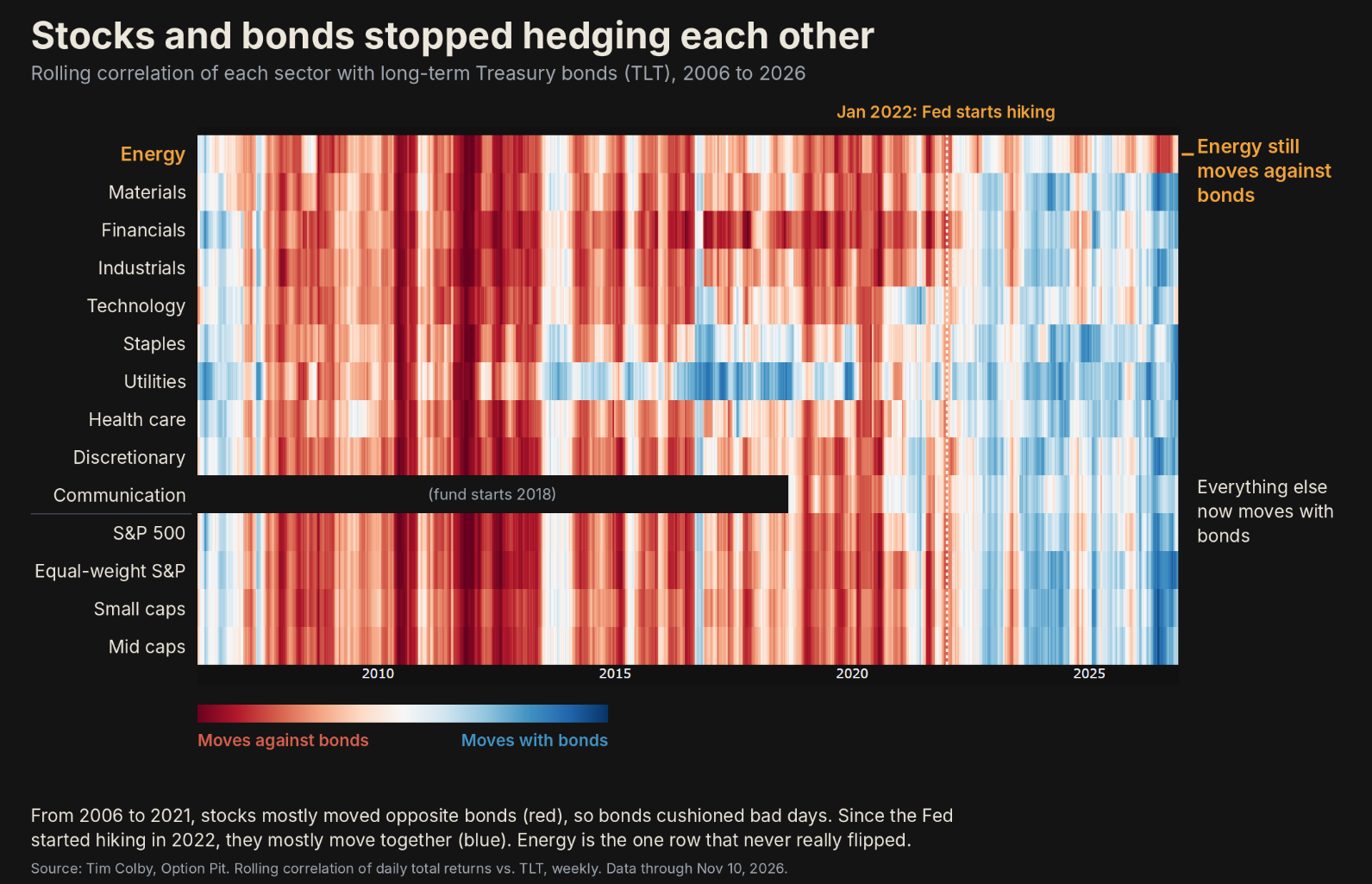
I ran a correlation matrix (a grid that shows which assets move together and which move opposite) of every sector in the S&P 500 against the iShares 20+ Year Treasury Bond ETF (TLT) going back to 2007. From then all the way through about 2021, the chart shows a wall of red, which means stocks and bonds went in opposite directions.
Then the Fed started its big hiking cycle in 2022 and the whole thing flipped to blue. Stocks and bonds started moving together. The worry shifted from growth to inflation, and the 1970s through the 1990s looked exactly the same way.
That flip explains why Thursday turned into a trend day down (a session that opens weak and grinds lower all day).
CPI (the government’s main inflation report) came in hot on Tuesday, and four Fed officials ran to the podium to talk up a December hike. The bond market took Wednesday off for Veterans Day. When it reopened Thursday it fell hard, and high yield credit (bonds from riskier companies), gold and Bitcoin went right with it.
Then Friday’s Producer Price Index (inflation at the wholesale level) came in a tenth soft at the headline. Bonds bounced and stocks tagged along. Once desks dug in and saw the core number (which strips out food and energy) still running hot, bonds rolled into new lows and stocks rolled over right alongside them.
The S&P 500 (SPX) dropped about 95 points with barely a bounce.
Last week the bond market sat in his La-Z-Boy while the semiconductors got hit, and that’s how I knew it was a positions story (traders cleaning up their bets). This week he got up, and he’s selling.
Where I’m Hiding
One row on that matrix jumped out at me because it never really flipped. The Energy Select Sector SPDR (XLE) has moved opposite bonds over long stretches of time. When bonds sell off on inflation, energy tends to rally, because oil usually does the inflating.
That’s been the story all of 2026. Every time oil spiked on Iran, bonds came off, and XLE turned into the only thing you could buy that actually hedged it.
And the oil story just came back. The market dumped crude into the election on hopes of an Iran deal, and Brent (the global oil benchmark) fell about 22 percent from its October high.
Then on Thursday, President Trump pulled Vice President Vance off the talks and said we don’t need a deal. The Houthis hit the East-West pipeline, the route Saudi Arabia uses to move crude around the Strait of Hormuz. By Thursday afternoon, energy names made up the only green on my sector board.
I don’t normally like buying oil or energy when fear drives it. Those moves usually reverse hard and fast. Energy lit up Thursday and I passed, because it looked like position jockeying (fast money swapping seats).
I slept on it and changed my mind. With Trump basically giving Iran a pass, I think XLE can just drift higher, a slow bleed up. It makes a better hedge here than the VIX (Wall Street’s fear gauge), which already came right back down.
A Low I Don’t Trust
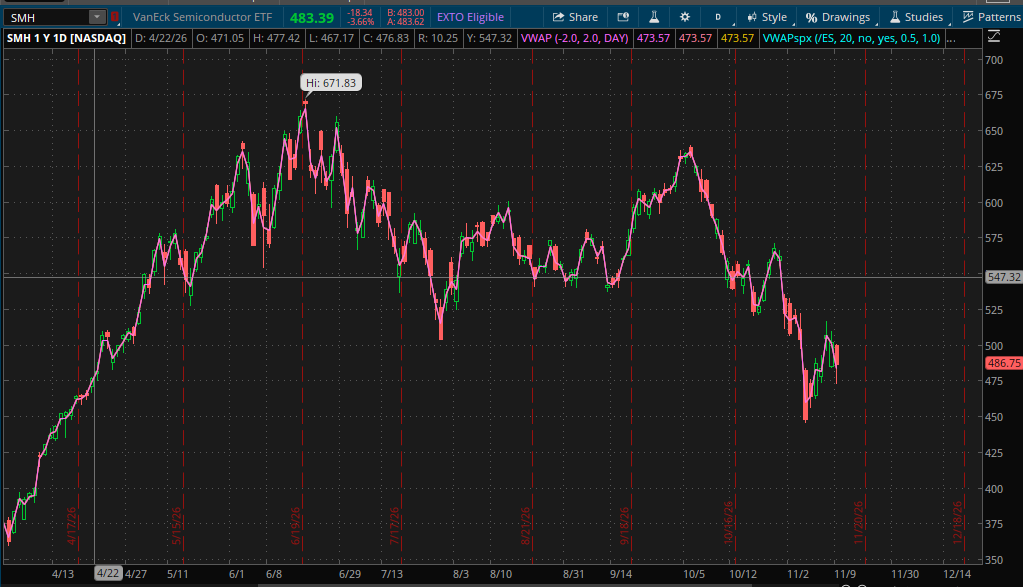
Last week I said I wasn’t buying the semiconductor dip, and we got what amounted to a big position wipeout (everyone in the crowded trade forced out at once). I also said I couldn’t tell if it was over. That low felt a little too easy to count as the real one, and now more headwinds have stacked up on top of it.
Nvidia (NVDA) reports Tuesday for the first time without Jensen Huang, Anthropic prices its IPO a day later, and the 10-year Treasury yield sits above 5 percent. I think that low needs a retest.
I’m flat on semis for now.
One thing gives me a little comfort: On Friday, with the semis leading the market lower, the Invesco S&P 500 Equal Weight ETF (RSP), where every stock counts the same, actually finished green. So did high yield credit through the iShares iBoxx $ High Yield Corporate Bond ETF (HYG).
The average stock isn’t panicking, and credit isn’t confirming anything worse. That tells me the selling mostly hit the AI trade, and the money rotated into the rest of the market.
When the Bus Turns Around
That stock and bond link defines the market season we’re in now. It reverses the day the market starts worrying about growth again instead of inflation. When that happens, bonds go back to hedging stocks, and everything we knew for the last 27 years works again.
Until then, with bonds driving the bus, stocks go where bonds go, and the place to hide is the thing causing the problem.
Size for the weather, not the headlines.
Nvidia makes the most noise out there right now, but bonds remain the one thing that can move everything at once.
Enjoy the journey,
Tim