

Hi Traders,
The Moab Trail Marathon has seven aid stations.
Mile 5.7, 9.7, 14, 17.5, 21.3, 23.3 and 25.2.
Water, Tailwind, oranges, salty snacks, and at least one with a fire pit and s’mores.
You plan your whole race around them.
You carry less because you know they’re there.
At the bottom of the race website, in small print, it says vehicles can’t reach the course anywhere else, so carry your own water if you think you’ll need it.

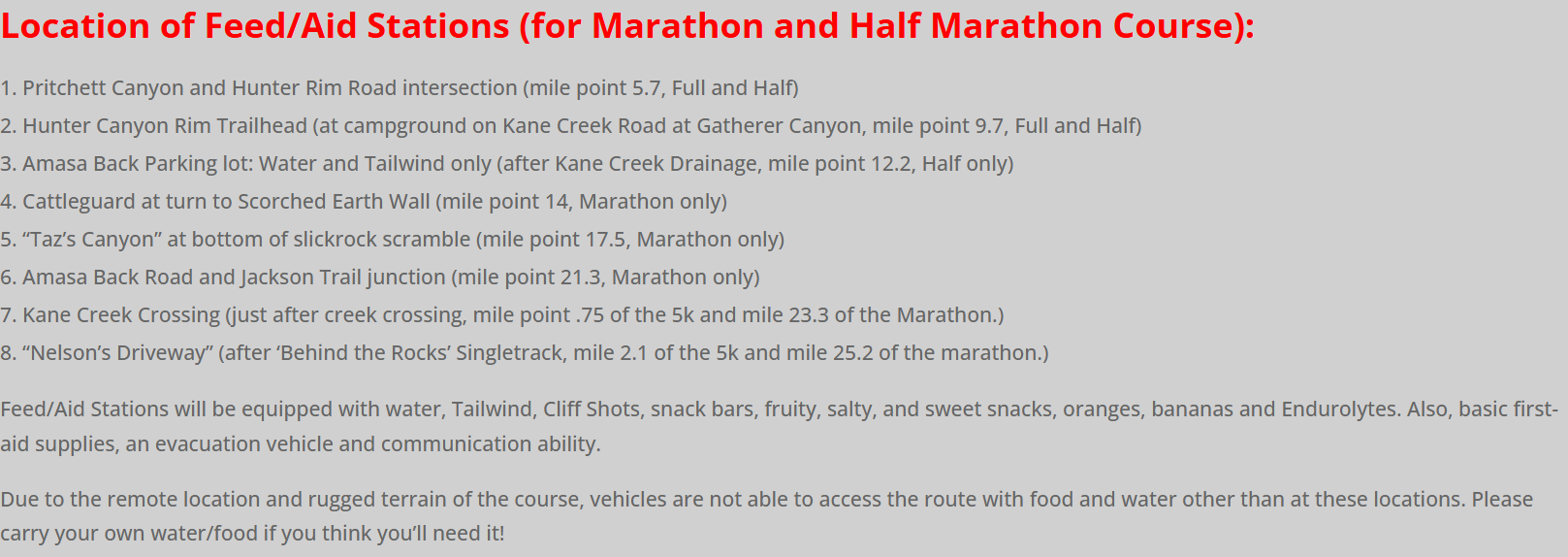
Now imagine the race director gets on the radio at mile 10 and closes the rest of the stations…
On purpose…
Because they want to slow the pace…!
That’s what the Fed did this week.

I’m coming back to this analogy of the Moab Marathon, because two weeks ago I laid out the course.
I said I wasn’t buying the dip in the Semiconductors because that positioning was so massive.
They’ve dropped another 15% since.
This AI build out is a marathon. Leverage is sprinting, and the sprinters were blowing up at their own pace while the rest of the field kept running.
That was true.
And the market was figuring the pace on its own. It’s not the whole story anymore.
What started as a de-risking wearing the costume of a slowdown has turned into the Fed making sure a slowdown happens.
The Fed wants inflation under control. The wobble in the AI trade gives them the opportunity, and they’re striking while they have it.
In their own words
The minutes from the October meeting came out Wednesday. This is how the Fed sees the build out:
“Many participants viewed the AI buildout as a material source of inflation risk.”
To the Fed, AI spending isn’t the thing to protect. It’s the thing running too hot.
Vice Chair Jefferson said it Thursday: the build out is exerting upward pressure on demand and inflation.
Then look at what they said about the market pushing back on it. When lenders get picky with the AI names and the stocks get sold, the Fed counts that as help, and they know their own hikes are part of it. From their own markets desk:
“Higher interest rates had helped lower equity valuations and had contributed to greater investor sensitivity regarding more highly leveraged borrowers.”
They’re closing the aid stations and patting themselves on the back.

And it’s not one voice. After the minutes dropped, they piled on.
- Barr said he expects it will be appropriate to raise rates further.
- Waller told CNBC the Fed might need to shock people with a half point in December.
- Williams said another hike is likely and called AI the stickiest part of this inflation.
- Musalem said several hikes before spring.
- Daly wants more at a measured pace.
- Kashkari said higher rates slow AI spending.
- Goolsbee said the job right now is to keep the AI surge from overheating the economy.
I can’t find one of them who said wait. The only argument is a quarter or a half.
They can see the runners on the side of the trail, too.
Chair Warsh laid it out Monday: after significant capital investment and stock market gains, expected returns could turn down, valuations could fall, and unemployment could rise.
He sees it.
They’re hiking anyway, because inflation is 4.1 percent. The warning was in the small print at the bottom of the website the whole time. Nobody reads the website.
Who’s the dog
I’ve been going back and forth on who’s the dog and who’s the tail.
You have the AI companies building as fast as they can, and you have the market financing them. For a year everybody lined up to fund it. If the Fed is going to pump the brakes on that financing with higher rates, then the Fed is the one wagging both of them.
Semiconductors (SMH) went back and tested the October low to the tick, like I said they would, and this week they took it out. Copper is down about 15 percent in a month. Dr. Copper speaks to the health of the whole economy, and it’s one of the signals that’s kept the Foundation out of trouble.
Here’s the strange part. When the market is scared of growth, money goes into bonds and bonds rally. Long Treasuries (TLT) are just sitting there. I ran it back to 2007. Copper has dropped 10 percent in a month 34 times. Bonds usually rallied. Eleven times they didn’t, and every one of those was with the Fed hiking. In the first piece I said long bonds were the hedge if this came true. They’re still the right hedge. They just won’t work as well as they normally would while the Fed is hiking, so my long bonds are sized like a pea shooter.
The field is slowing
At the end of October, 14 of the 16 groups I track were up on the month. Wednesday it was eight. Thursday it was six. Going back to 2006, when the S&P is down seven percent in a month, the most groups that were ever still up was four. More than half the time it was zero. So six says this is still a market selling what it owns too much of, not selling everything. Chips down almost 20 percent on the month, tech down 15, the equal weight S&P down about two.
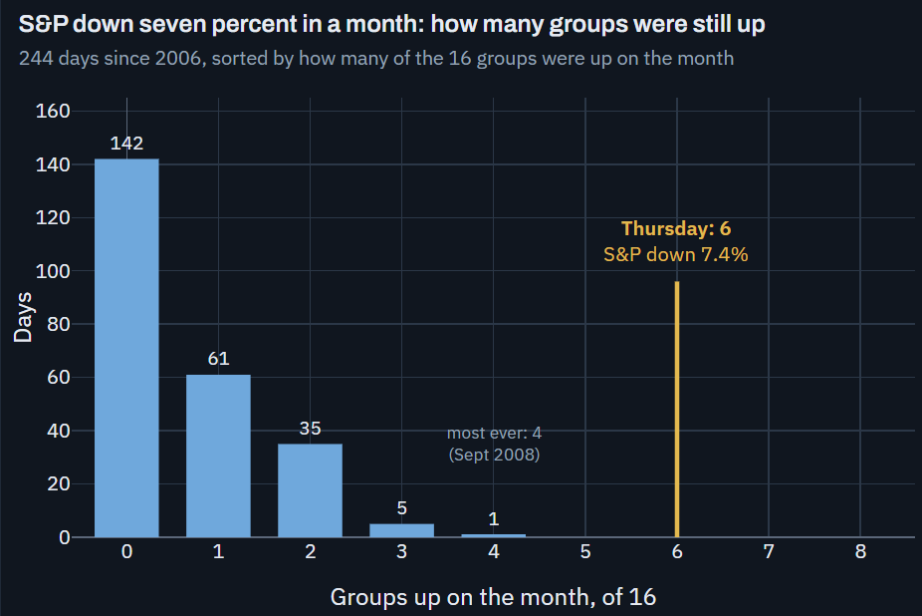
What I don’t like is the direction. If the Fed keeps the aid stations empty. Six goes to zero. That’s how de-risking becomes a slowdown.
The risk is that something breaks in the process.
When does the Fed restock the Aid stations?
The Fed doesn’t react to the S&P, it reacts to inflation and jobs. But I can’t trade inflation, so the S&P is the best gauge I’ve got.
In 2016 the S&P fell 13 percent and they paused for a year, with inflation under one. In 2018 it took 19 percent and a Christmas Eve low, with inflation at two. In 2022 they never put back the aid stations. The S&P fell 25 percent and they hiked the whole way down, with inflation over eight.
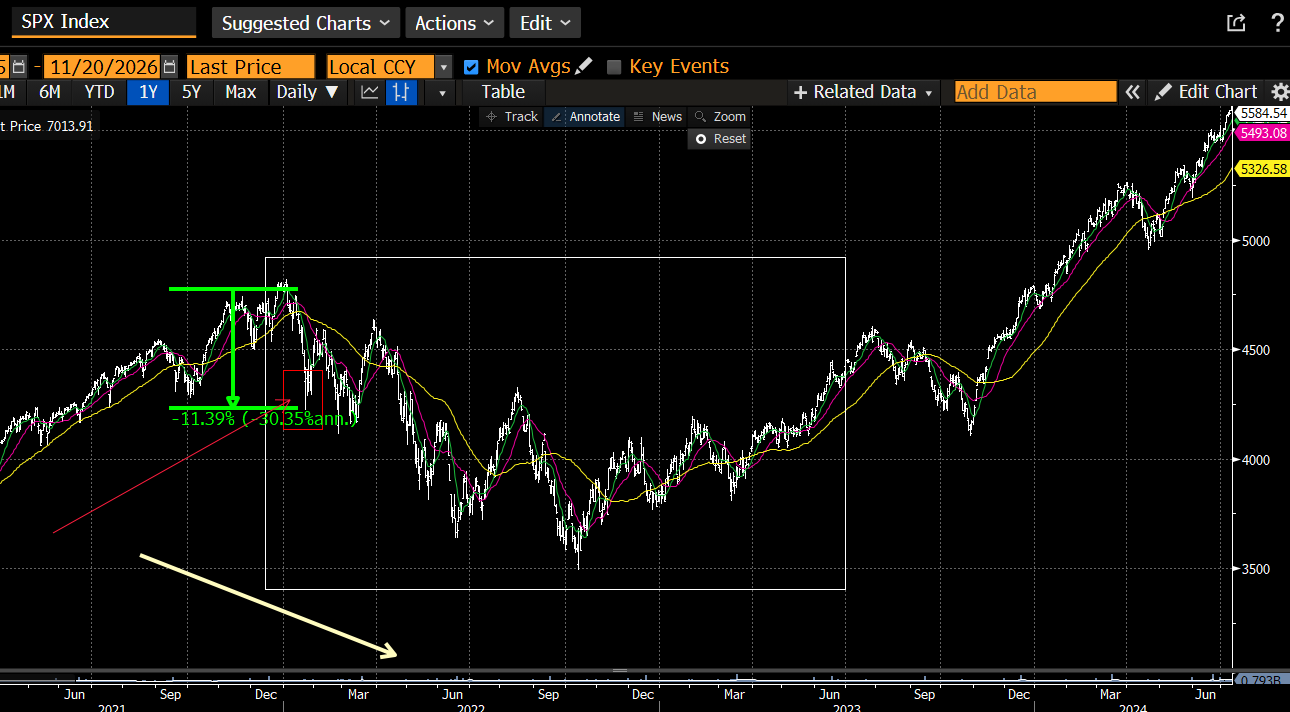
We’re ten percent off the high with inflation at 4.1. On the Fed side, this is 2022. On the market side it isn’t yet. That gap is the whole trade.
Survival pace
Bearish and short are two different things. Yes, I’m bearish. I’m not loaded up on puts, because the rallies in a market like this are violent. I think we are in for a bumpy ride like 2022. In 2022 the S&P moved two percent or more on 46 days, 23 up and 23 down. It rallied five percent or more seven different times, and still finished down 19. Since 1983, when the S&P has dropped five percent in a month with the Fed hiking, it was higher three months later in 20 of 24.
The bars are twice as big as they were at the October high. That’s a bucking bronco, and it bucks both ways. The lows get bought and the bounces stall.
So you don’t race this course. You play to survive it. Walk the uphills, which means tactical longs near the bottom of the range. Jog the downhills, which means having offers out into the top end of the range. Play small have defined stops. The market moves will be big enough to pay even small positions. Don’t sprint in either direction. And carry your own water. Cash is the main position.
The Fed is trying to slow the race, they aren’t trying to kill anyone.
Two things would change my mind. Credit, if credit markets start to crack. Someone is gonna need an ambulance. Keep an eye on High Yield Corporate Credit (HYG).
The Fed will blink if something breaks. Jobs is the other one. The four week average of claims is 198,000. This isn’t a slowdown until that starts climbing. So I’ll be watching for headlines around layoffs.
Here’s the strange part: If either of these start to happen, that’s probably when the Fed puts the aid stations back out there.
Bad news will become good news (for stocks).
In the Foundation, we’re currently flat. Our macro signals are all off. There are some positive readings out there. But over this 10% sell off in the S&P 500 we’ve managed to book 12 of 14 trades with an average win of 31%. That’s from using macro signals to have selective long positions in different sectors at different times.
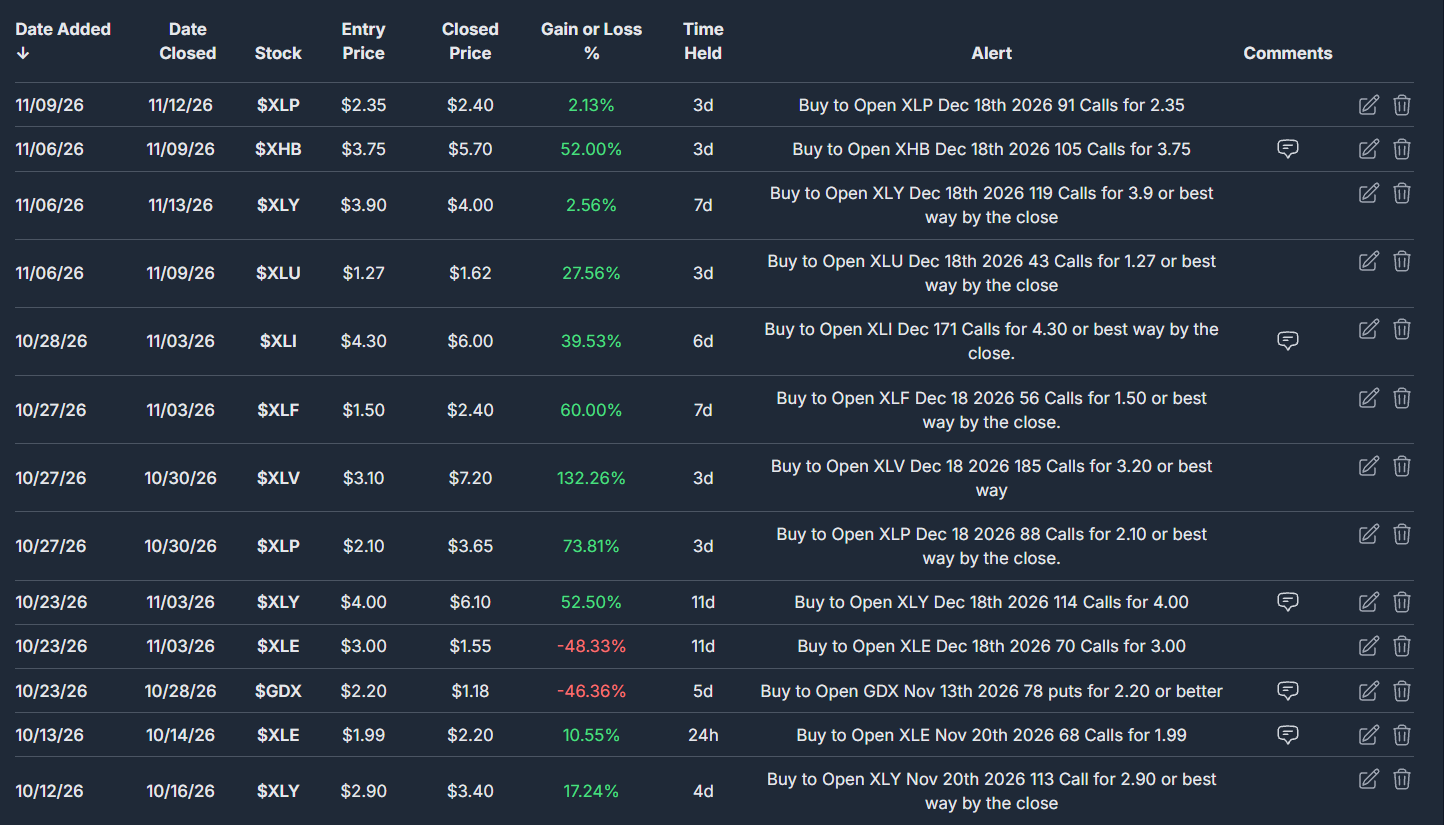
The course sets the pace. This week we are reminded that the Fed sets the course. The Fed meets December 9. It’s gonna be bumpy until then.
Enjoy the journey,
Tim