

In April the software sector was being taken apart.
More than $2 trillion in market cap gone. IGV down 22% on the year. Everything with the word software attached to it was being sold on the assumption that AI agents would eat the business…
We published research saying four of those companies did not belong in that selloff…
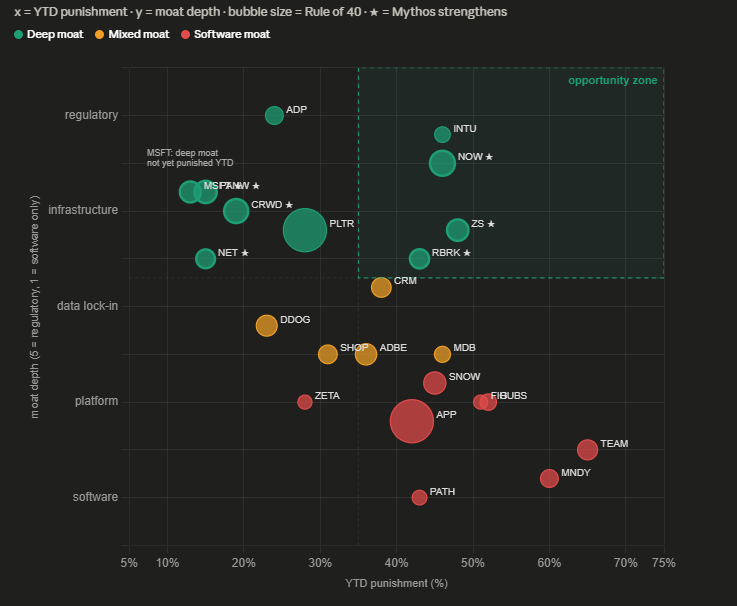
Since then ServiceNow is up about 45%, Zscaler about 39%, and ADP about 39%.
Let me be clear about what that trade was, because it was not a prediction about artificial intelligence.
It was about price.
Those stocks got knocked down 50, 60, 70 percent, and while it was happening there was no material change to any of those businesses. The valuations got cut and the businesses did not.
Warren Buffett might like a business, but he wants the right price. Price is what makes a trade interesting rather than just a company you admire.
When something moves to fifty-two week lows it does not mean you should buy it. It means it might be worth taking a look at.
The checking account problem
Here is how I think about switching costs, and it has nothing to do with software.
A bank will give you a toaster to move your checking account over. And it is such a pain in the neck that even though you are getting a free toaster, you do not do it.
Same thing with these companies. Enterprises pay people to monitor all their systems, and they have a trust level built up over years with the vendors they already use. Nobody is picking that up and walking.
Think about your own accounts for a second. Have you dumped your Microsoft, or any of the rest of it?
My son was here for the summer using Claude inside Excel, and there may come a day when that replaces Excel entirely.
But first somebody has to take Excel off five hundred million desktops, which is not a two-year project.
The question that separated them
The distinction I kept coming back to is whether the app is the business.
For some companies it is. Adobe makes something that cleans up your photos and your video, and Claude is a direct competitor for that. I think it is part of why Autodesk has been suffering too.
When the product is the whole business, AI stops being a headwind and becomes a rival. Those companies deserved what happened to them, and a lot of them are still sitting at the lows.
Then you have the ones where the app was never the business. ADP is not a payroll app. It is a compliance relationship with the IRS and fifty state tax authorities that took five decades to build.
Am I going to hand my entire payroll system over to some nebulous thing on the cloud? That one was a relatively easy call.
ServiceNow was the same argument.
It is the operational infrastructure of 85% of the Fortune 500, and replacing it means rebuilding years of custom configuration across every department at once. Zscaler is the network layer every enterprise user routes through, built over 17 years across 160 data centers.
None of that is code you can regenerate.
How I traded it versus how I invested it
I did the calls in Special Situations and they doubled or went up 60 or 70 percent, and I sold them.
You never know what is going to happen, and a call has an expiration date attached to it, which changes how you have to think about the position.
The stocks I bought personally I do not have to sell. I bought ADP and I bought ServiceNow, and I am still in both, because nothing about the reason I bought them has changed.
Same research, two completely different instruments, two completely different jobs. That distinction is most of what Special Situations is.
Not every one worked
S&P Global was the fourth name and it has gone nowhere, sitting at $409 against $415 to $430 in April.
Looking back, it was the one company on that list that was never a SaaSpocalypse victim. It was 26% off its high while the others were 55% to 65% off. The market was pricing a bond issuance cycle normalizing, not AI disruption, so there was no panic discount to correct.
The business is fine. Second quarter revenue grew 11% and adjusted earnings grew 23%. It just was not the same trade.
It is hard for everybody to be right about the future, and I am not going to pretend otherwise.
But the three that were genuinely mispriced by that panic are up roughly 40% in four months, and the businesses never changed. Only the prices did.
These are the situations we hunt for.
A whole sector gets sold on one story, and inside it are companies where the story does not apply. The price moves 60% and the business does not move at all.
That gap is the trade. It does not happen often, and when it does you have a window before the market works out which is which.
That is what Special Situations is for.
Andrew Giovinazzi