

Hi Traders,
Every major index closed lower Tuesday.
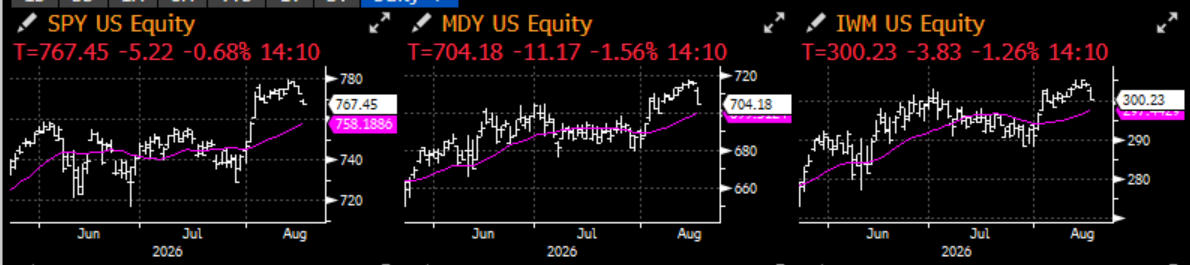
My sector ETF book closed higher.
That combination isn't supposed to happen. The Macro Barometer, my sector ETF system, buys funds and doesn't short them, so a session where traders dump risk should leave it red with everything else.
It didn't. Here's what was happening underneath, because days like Tuesday are the reason I built the thing.
Semis Took the Punch
The S&P 500 gave up about seven tenths of a percent. Midcaps dropped 1.6 percent and small caps 1.3. Glance at your screen and you'd call it a run for the exit.
Now look one level down. The VanEck Semiconductor ETF (SMH) fell 4.1 percent while the Health Care Select Sector SPDR (XLV) gained 1.6 percent, the Energy Select Sector SPDR (XLE) added 1.8 and the Consumer Staples Select Sector SPDR (XLP) picked up 1.1.
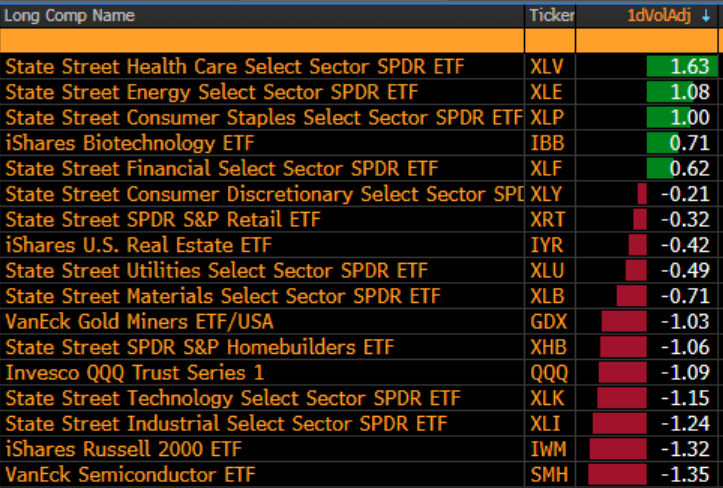
That's the same session that produced those red headlines. On a volatility adjusted basis (scored against how much each fund normally moves, so a quiet fund's one percent counts for more than a jumpy one's), health care and staples finished at the top of my board and semis and the iShares Russell 2000 ETF (IWM) finished at the bottom.
There's real worry out there and I won't pretend otherwise. The 30-year Treasury yield tested 5.3 percent this week, its highest since 2007, and crude is sitting near 85 dollars with the Strait of Hormuz still closed to most traffic. Expensive money and expensive oil hit the companies that borrow heavily to build, which is most of the chip complex.
Traders are asking what that does to credit. Fair question. But look at where the selling actually landed before you answer it.
Why I Stopped Picking a Favorite Indicator
Traders say the market "feels" weak. That feeling is real. What took me two decades to accept is that most of it is measurable.
There are dozens of ways to take the market's pulse. Junk bonds against investment grade. The path of the 10-year. Crude. Jobless claims. Staples against discretionary. Semis leading or lagging the Qs.
Any one of them, by itself, is close to useless. Every trader I know has a favorite indicator, and every one of those favorites is wrong often enough to hurt.
So the Barometer doesn't pick a favorite. It takes dozens of inputs, lets each one vote on whether a slice of the market has a tailwind or a headwind, and reports the tally. That tally describes what's happening now. It doesn't forecast what happens next.
Right now the book is long health care, energy and the Invesco QQQ Trust (QQQ). The Qs signal has been on since August 4. Tailwind votes there fell off hard this week.
And that's the part of Tuesday I actually like. The Barometer was long QQQ, one of the worst performers on the board, and the book still finished green. Health care and energy carried it.
Those three positions weren't picked to hedge each other. Each one got there on its own macro signal, independently, on its own timeline. They just don't all break on the same afternoon.
The Money Had to Land Somewhere
Here's how you know Tuesday was rotation and not an exit. Money leaving the market has to go somewhere, and it didn't go anywhere defensive.
The iShares 20+ Year Treasury Bond ETF (TLT), where cash runs when people are genuinely scared, added four tenths of a percent. Gold dropped 1.7 percent. Neither one behaves like that when the market is heading for cover.
Money left semiconductors and small caps and went into health care, staples and energy. It stayed in the building.
You can't see that in the S&P, the midcaps or the Russell. Those are three cap-weighted indexes, all red Tuesday, each one accurate and each one missing most of the story.
The market has a lot of moving parts. Sit still long enough to look at all of them and you'll read days like Tuesday correctly while everyone else is reading the headline.
And over the next coming week, I'll reveal more about my macro barometer and invite you to the event I'm hosting to announce and show it off live.
Enjoy the process,
Tim