

Hey Trader,
Ask a chatbot what an option’s worth and you’ll get an answer down to the penny.
It’ll show the formula, walk through the steps, and sound like a guy who’s done this for 30 years.
Don’t be fooled.
Every option price has a guess baked into it. If the bot guesses wrong, the math can be perfect and the price still comes out wrong.
Let me explain…
Blame the Traffic
Think about the arrival time on your GPS.
It’s one part fact, another part crystal ball.
It knows how far you’re going and what the speed limit is. Those are facts.
But traffic? Yeah, that’s a guess based on some assumptions and history.
If the traffic estimate is off, you’re late, even though the GPS did its math right.
An option price works the same way.
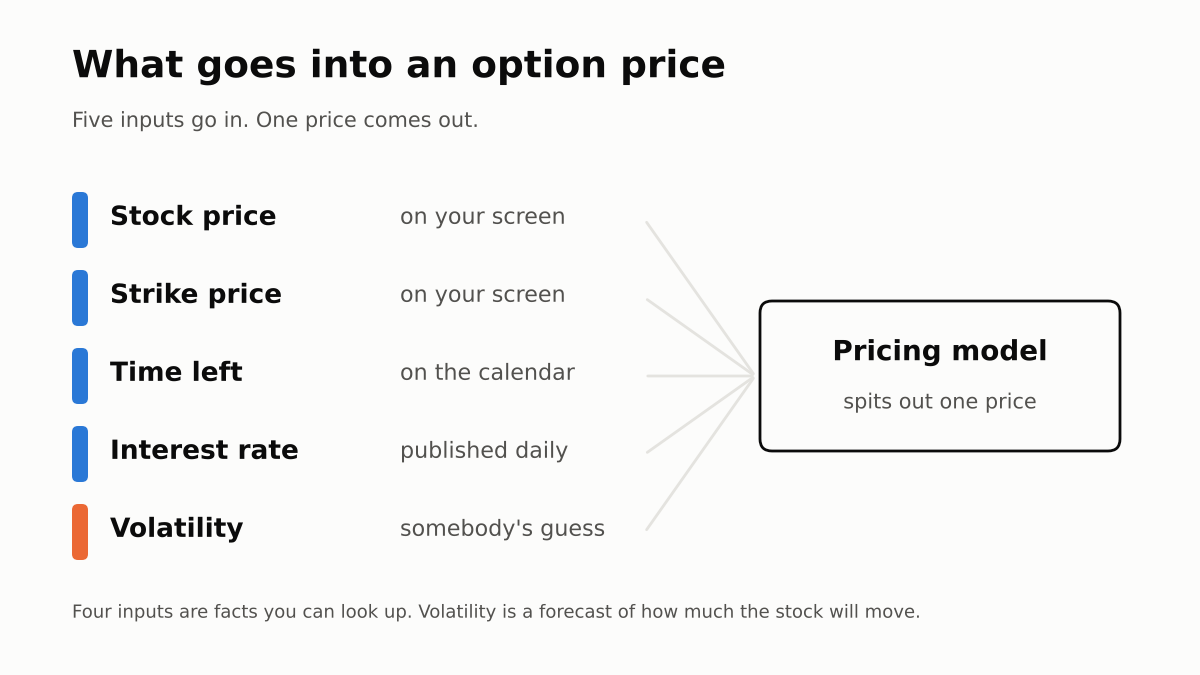
The price of an option is calculated using five different things.
Four are facts anyone can look up: the stock price, the strike price (the price your option lets you buy or sell at), the time left, and interest rates.
The fifth is volatility, the market’s forecast of how much the stock will bounce around before expiration.
On your GPS, that’s traffic.
A chatbot doesn’t have today’s volatility unless you hand it over or it goes and looks it up. And even if it had that number, volatility never sits still.
That constant movement makes it super hard to accurately price options on the fly.
And sometimes, the difference is big.
Say a stock trades at $500. You want the price of a $500 call that expires in 30 days.
If the bot assumes 20% volatility, the formula says your option is $12.26.
If the real number is 35%, the formula says $20.81.
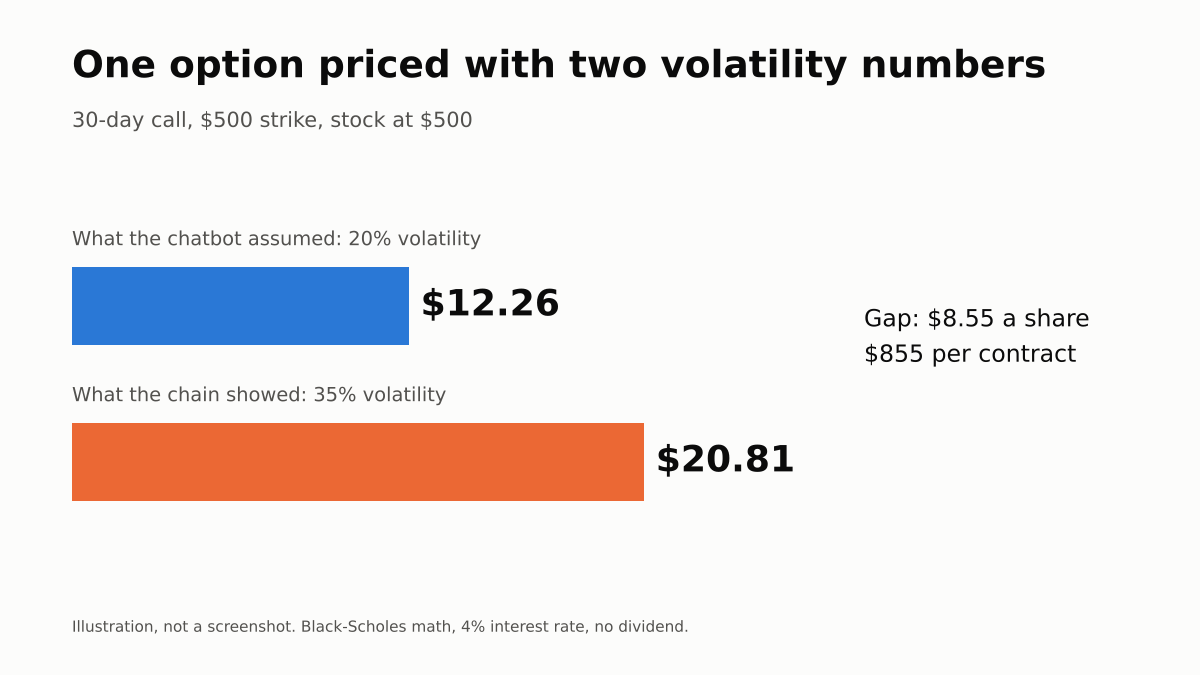
Nothing changed between those two prices except the volatility number.
The gap is $8.55 a share.
One contract covers 100 shares, so that’s $855 on a single contract.
All of it comes from an input that, if you’re not paying to get it from a data broker, is made up.
A bot can also guess wrong on how much time is left, or use a formula built for a different kind of option.
I’ll get to those another day.
Your Broker Already Graded It
I’m not telling you to quit using AI for options. I build trading tools with it. You just have to constantly double check your results so you can find where the issues are and address them.
So here’s the first thing you should do..
Before you accept a price, ask the bot which volatility it used and where that number came from.
Then pull up the option chain at your broker (the table of live prices for every strike) and compare it to the market’s price.
If the chatbot and the chain disagree by more than a few pennies, go with the chain and make the bot explain itself.
So why would you even want your bot to price options when you can just go to your broker? Well, getting historical option prices is extremely difficult (and costly). And you need historical option data if you want to do a comprehensive backtest to make sure your trading strategy really works.
When I ran into that, I had the bot create a whole option pricing system. It was horribly off. I couldn’t trust it.
My solution? Have my bot put together a database of real-time option prices on a couple specific tickers, and just let it build.
Now, when I want to backtest, I have 10 months of data to go by. While that’s definitely not enough for a comprehensive backtest, it gives you a good idea of what’s working and what’s not.
As I’ve always told my kid, AI is a tool. It has its strengths and weaknesses. Your job is to know what they are so you can use it with confidence.
Charlie Delvalle
Editorial Director, Option Pit