Dear Trader,
I want you to pull up two charts before you read another word of mine. Lay them side by side and you’ll swear somebody flipped one of them upside down.
The first chart is the iShares 20+ Year Treasury Bond ETF (TLT).
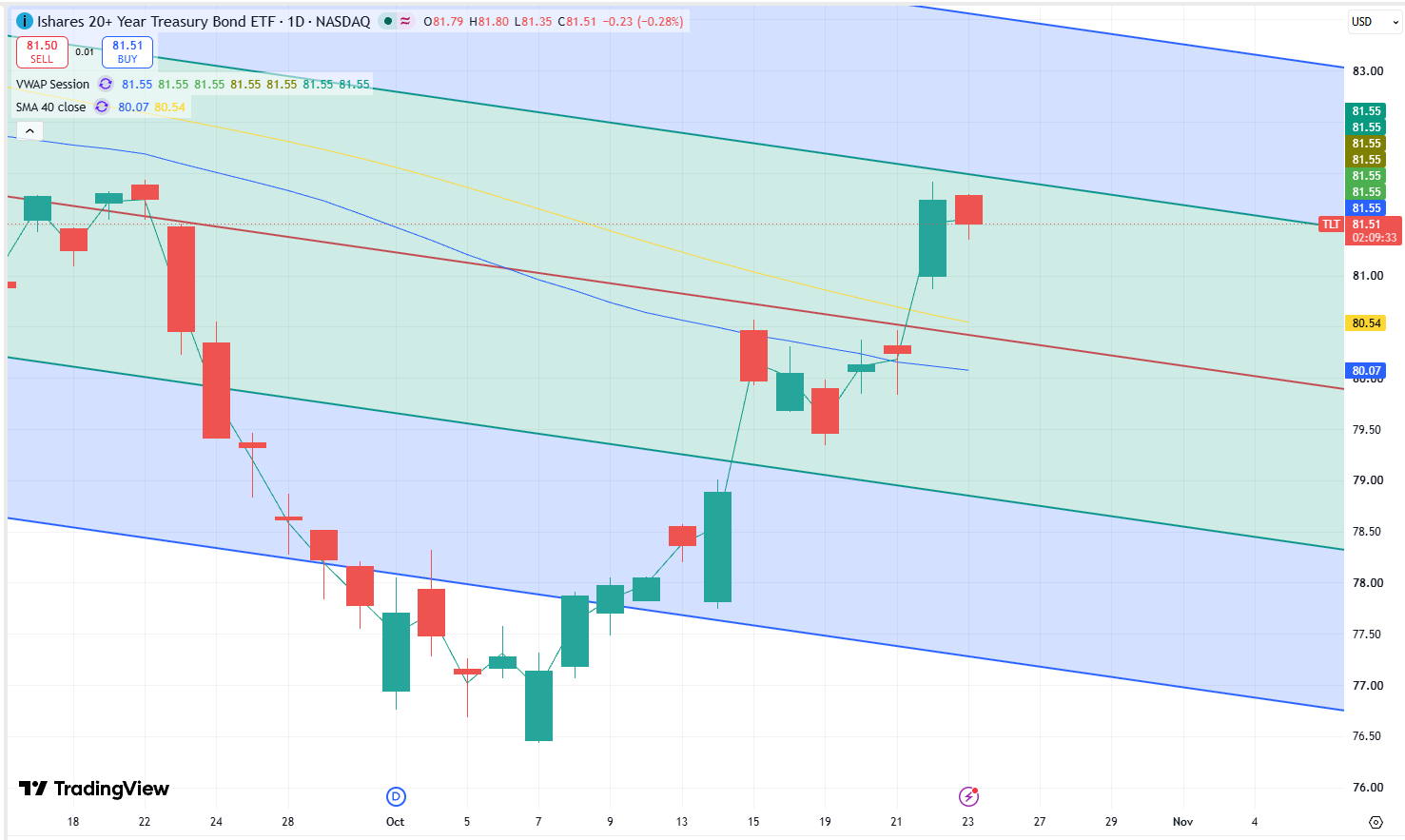
TLT closed at $81.75 on September 22nd. Then the long bond fell apart, the 10-year yield climbed to 5.3 percent in the first week of October, and TLT sank to around $76.50, its lowest level since 2023. On Friday it closed at $81.36, about 40 cents from where it started.
The second chart is the Invesco QQQ Trust (QQQ).
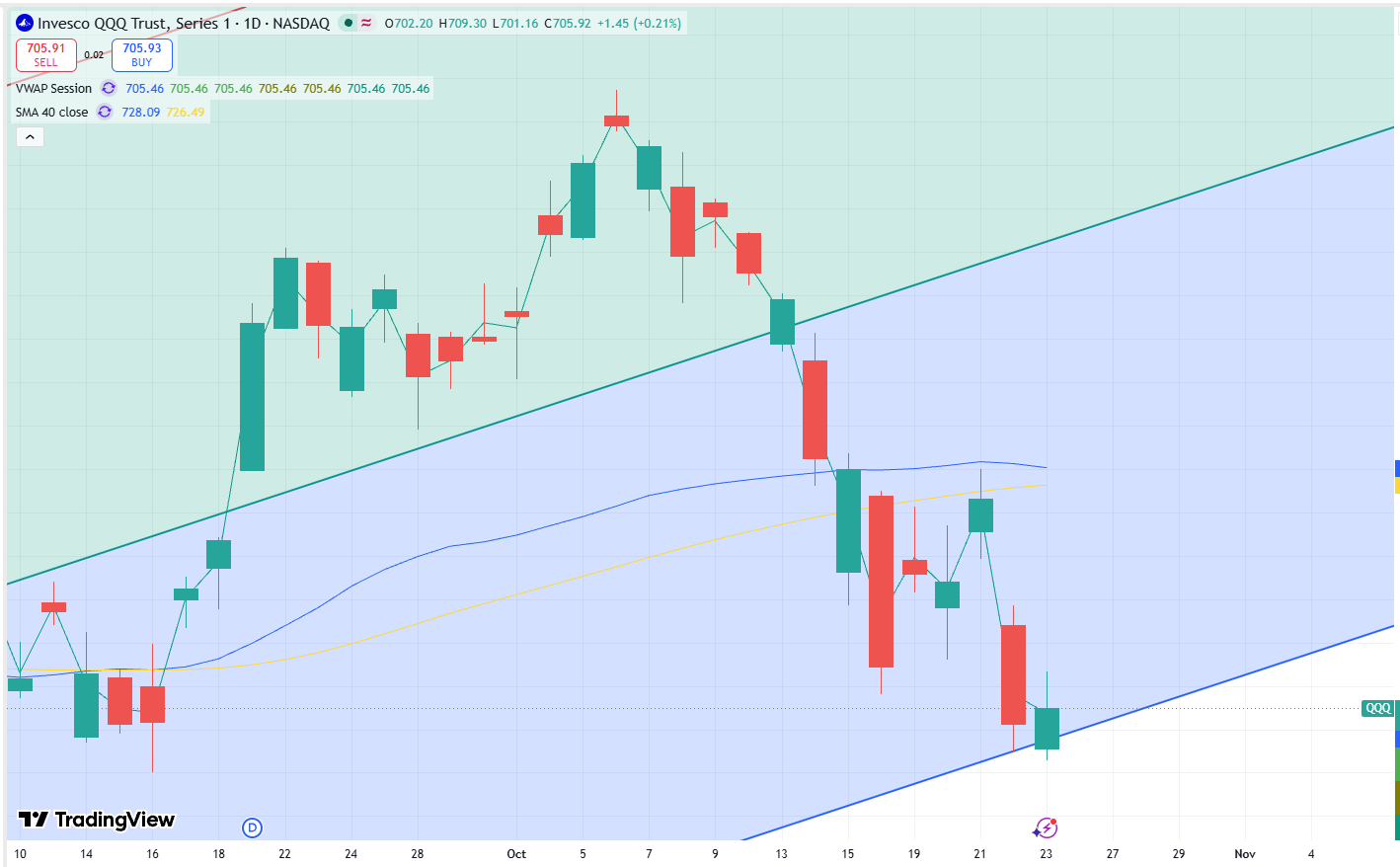
The QQQ closed at $704.72 on September 16th, the day the Fed hiked. For the next three weeks, money rushed into tech and out of bonds, and the QQQ topped out at $762.86 on October 6th, the same day the Nasdaq hit an all-time high. Then money rushed back into bonds, and the QQQ closed Friday at $704.40, 32 cents below hike day.
Over the course of a month, both moved BIG and ended up exactly where they started. To me, that points to how over-inflated the AI trade got and how oversold and aggressive the bond short was.
Now that both are back to equilibrium, the winners in the AI trade will start to separate themselves from the losers. Bonds should go back to reacting the way we’d expect, to inflation and economic data.
We’ve got a huge week ahead to test that. Microsoft (MSFT) and Alphabet (GOOGL) report Tuesday, the Fed makes its call Wednesday, and Amazon (AMZN) reports Thursday, the same day we get PCE (the Fed’s favorite inflation gauge). Earnings matter again, and so does spend.
Meta Platforms (META) is a clear example that spend is a problem whether earnings are great or not. Revenue jumped 26 percent to a record $64.6 billion, and the stock still fell seven percent Thursday, wiping out about $124 billion in market value.
Meta spent $34.9 billion on capex (money poured into data centers and servers) last quarter, more than the $32.8 billion in cash its business brought in. That pushed free cash flow (the cash left over after that spending) negative for the first time since Meta went public. Then management raised its future spending commitments to $825 billion from $700 billion.
Wall Street Only Heard Half the Call
International Business Machines (IBM) came out of the gate down after earnings, even though Big Blue beat on just about everything Wednesday. Revenue hit $17.1 billion against $16.82 billion expected, adjusted earnings came in at $2.95 a share against $2.86, and software grew eight percent. IBM also raised its free cash flow outlook.
The stock jumped seven percent after hours, then reversed in the middle of the call when CEO Arvind Krishna said customers are questioning what they’re getting back on their AI spending. By Thursday’s premarket, it was down about six percent.
That has changed. The company ended Thursday green and kept rallying Friday to close at $253.29.
Listen to the rest of what Krishna said. Clients want help redesigning how they work and reining in what they spend on AI, and he called that a tailwind for IBM. Its use of AI to directly help customers, rather than counting on end users to figure it out themselves, has made IBM a sneaky AI winner.
Back on July 14th, IBM fell 25 percent in a single day on a preliminary earnings miss, its worst day on record. It dropped from about $290 to $217 and left a gap on the chart (a price range the stock skipped right over). I like the stock to start closing that gap and potentially run to 280 or higher, and Jefferies raised its target to $280 on Thursday, so I’ve got company.
The Landlord Might End Up With the Keys
You heard me say above that we’re going to start seeing the winners and losers in AI separate. One of the losers is clearly CoreWeave (CRWV).
The stock’s down about 36 percent in October, including a 10 percent drop on Thursday. The bonds look even worse: CoreWeave’s unsecured debt yields around 15 percent, and its 2031 notes trade below 80 cents on the dollar. Its credit default swaps (insurance that pays out if a company can’t pay its debts) hit a record last week that works out to roughly 60 percent odds of a default within five years.
Debt costs are exploding. In the second quarter, CoreWeave paid $640 million in net interest and posted a $626 million net loss. Strip out the interest, and the business roughly broke even.
On top of that, about $7.5 billion of debt comes due within a year of June 30th, and the company plans to spend up to $39 billion on its buildout this year.
I’m also seeing huge put buying. Nvidia (NVDA) CEO Jensen Huang said last week he doesn’t think Nvidia needs to backstop CoreWeave, and Nvidia already owns about 10 percent of it.
I think this company probably ends up in receivership (a court-appointed manager takes over and sells off the assets), with the assets owned by NVDA or one of the other data center companies.
Over the long haul, it’s probably going to zero, and in the near term, below 30.
Will either of these become the trade of the week?
I’m going to root for them this Monday after the State of the Market. To get the final play, make sure you’re a member of the Ticker Highlight Show by tapping this link.
Your only option,