

Hey There Income Hunters,
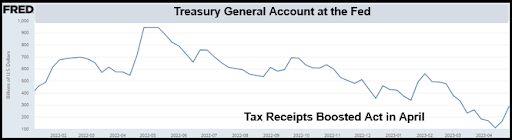
April’s tax receipts came in lower than expected … this moves the deadline closer and it could hit before the summer.
The debt ceiling crisis will have liquidity implications for markets that you need to know about.
The bottom line is this:
US tax receipts are down YoY plus the US budget deficit is now at 8% of GDP. For the fiscal year, that amounts to $2.2 trillion that will need to be printed just to fill the gap.
Today, we’ll dive into what this means for markets before and after the debt ceiling is resolved.
Debt Ceiling
Congress is in charge of approving government spending (debt ceiling). The US Treasury department is then in charge of issuing bonds to pay for the spending.
Congress has raised or suspended the debt ceiling 78 times – 29 times under Democratic presidents and 49 times under Republican presidents.

A Delay in Passage Process
When the debt ceiling is not increased as it normally is, the U.S. Treasury Department begins to take what they call “extraordinary measures”:
-
-
- The Treasury, Janet Yellen, will draw down its existing cash balance to fill the gap.
-
-
-
- The Treasury will also temporarily stop reinvesting soldier and federal civilian retirement holdings in Treasuries, which frees up another $300 billion or so.
- When these measures are tapped out the risk of an actual default occurs. Then payment on Treasury securities that mature are defaulted on due to an insufficient cash balance.
-
Temporary Default
Temporary default would negatively impact the country’s credit worthiness … This can be seen by the price you would pay for insurance against a US default.
The chart below is the credit default swap spread (CDS), which reveals a cost of .83% that you pay as insurance against default.
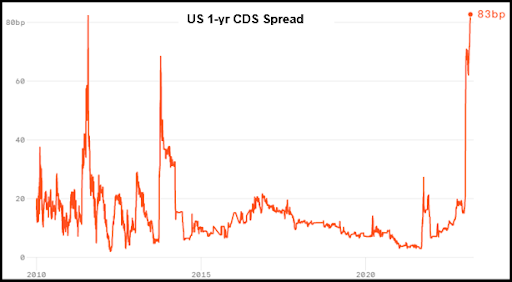
A temporary default is likely this year. However, the odds of a permanent default are zero, since it would cause a financial system meltdown.
Beyond a Debt Ceiling Approval
When the debt ceiling is raised, the Treasury Department will begin issuing more government bonds.
More bond issuance will be very negative for liquidity, assuming the Fed is still reducing their balance sheet at that point with quantitative tightening (QT).
This will be very negative for stocks and bonds at a time when recession is in full swing.
In Summary:
The clock is ticking on the Fed. There are 3 possible solutions:
-
-
- Pivot back to quantitative easing to buy the increase in bond issuance post debt ceiling passage a la Japan.
- Kick the can down the road by issuing a ton of short-term Treasury Bills and suck money out of the reverse repo facility ($2.2 trillion).
- Let the dollar weaken significantly in hopes foreigners increase their US bond purchases with offshore dollars. This is a stretch with foreigners selling bonds to buy gold and alternative currencies.
-
Each scenario is inflationary, which will push more money out of financial assets into real assets.
Stay tuned for more details as this process unfolds …
Live and Trade With Passion My Friend,
Griff