

Dear Trader
Traders and investors get along fine most of the time.
But there are environments that favor trading and environments that favor investing.
I've been calling this a "trader's market" in a couple newsletters and on State of The Market for the last few weeks.
I just realized I never gave you the quickest way to tell we're in one.
VIX futures (contracts that let you bet on where volatility is headed over the next several months).
Some of you have never looked at these and might be saying, "Tim, I don't know what that is and I don't care."
You should care.
You need to care.
I know we're in a trader's market right now, without question, by looking at one line:
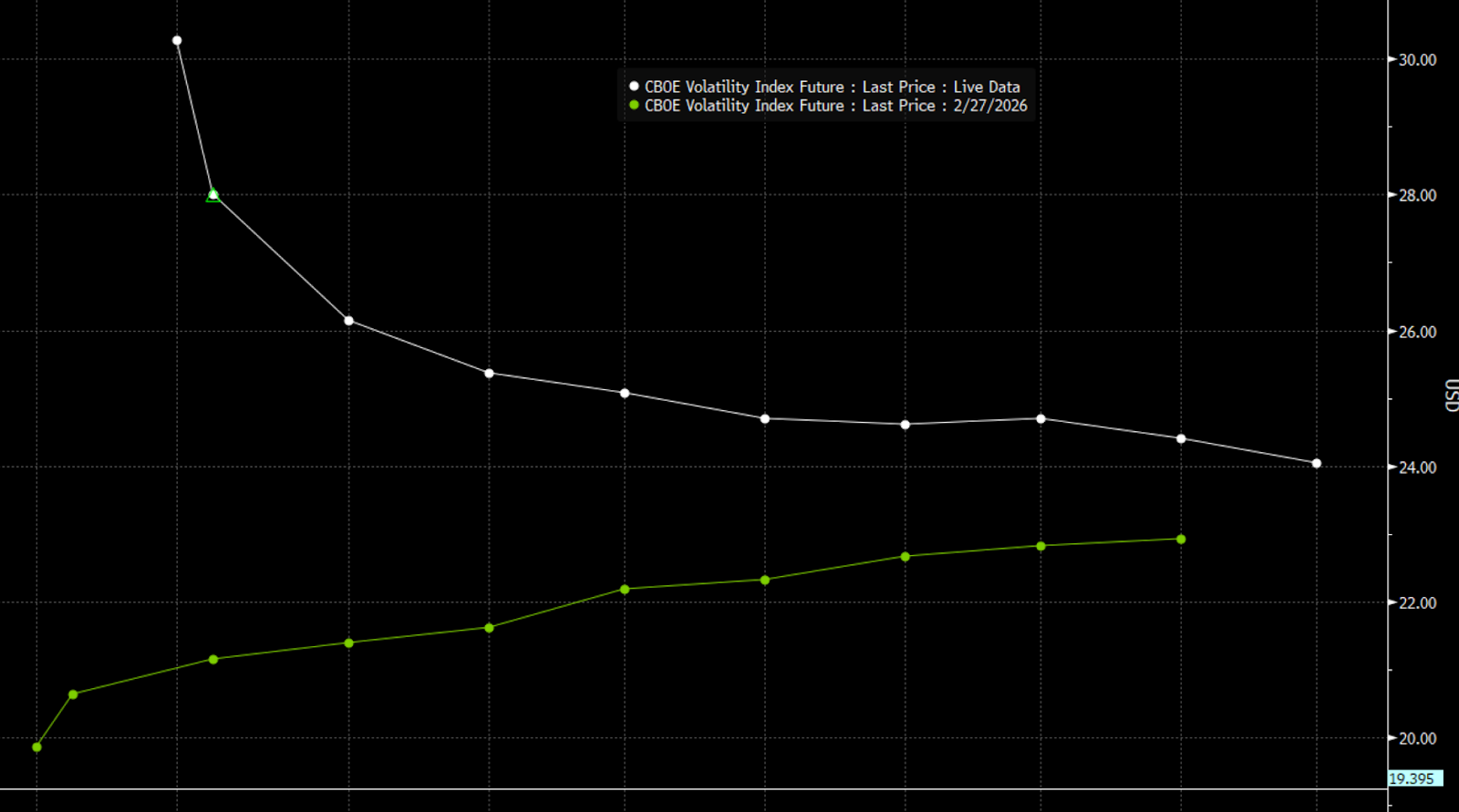
The white line is where we are today, 3/27/26. The green line is the Friday before the war broke out, 2/27/26.
Notice the green line starts low and gradually moves higher? That's the market saying the further-out dates are more uncertain than the near-term dates.
The slope of the white line? Steep as a double black diamond. That's the market saying right now is far more uncertain than the future.
The VIX Curve Is Screaming
This is the VIX futures curve, and right now it's in something called backwardation (near-term fear is priced higher than future fear, like flood insurance costing more during the storm than after). The VIX curve only sits in backwardation about 15 percent of the time. It flipped to this position on March 2nd, the first day the market opened after the war, and it's stayed there since.
When you see this, TRADING IS KING. The market moves in big, fast swings that don't last. Daily ranges run two to three times normal. Stocks gap down on a headline and rip back by lunch. Nothing trends for more than a day or two.
Longer-term strategies get beaten up in this environment. Short-term trading thrives in it.
How to Track This Yourself
To track backwardation yourself, you can find the VIX Futures Curve in trading view to visualize this for free. But you can set this up on any trading platform. As the CBOE notes, it’s not necessarily a sign of a future down market. But it is the literal definition of high volatility. And as traders, we love that.
As traders, we love that.
A smart trader knows the market environment at all times. Knowing the environment helps you adjust how you interact with the market and which trades have the highest probability of winning.
High volatility means everything moves around more. Fundamentals take a back seat to flow and positioning. People struggle to value stocks, so technical analysis works better because more people rely on it to price the movement.
This Is When Traders Eat
And this is exactly why we trade options. When daily ranges are two to three times normal and nothing trends for more than a day or two, options let you define your risk, get paid on the movement, and stop worrying about a headline blowing up your account. Big swings and defined risk: that's what options were built for.
Next time someone asks you what's going on with the market, tell them the VIX curve is in backwardation. It only happens 15 percent of the time. Everyone else is panicking. The traders are getting paid.
If you want to learn how we're trading this environment, Project MNS and Trade the Close are where we're doing it every day.
Tim