

Hey Income Traders,
The AI trade isn't just about chips anymore. It's moved into the real world.
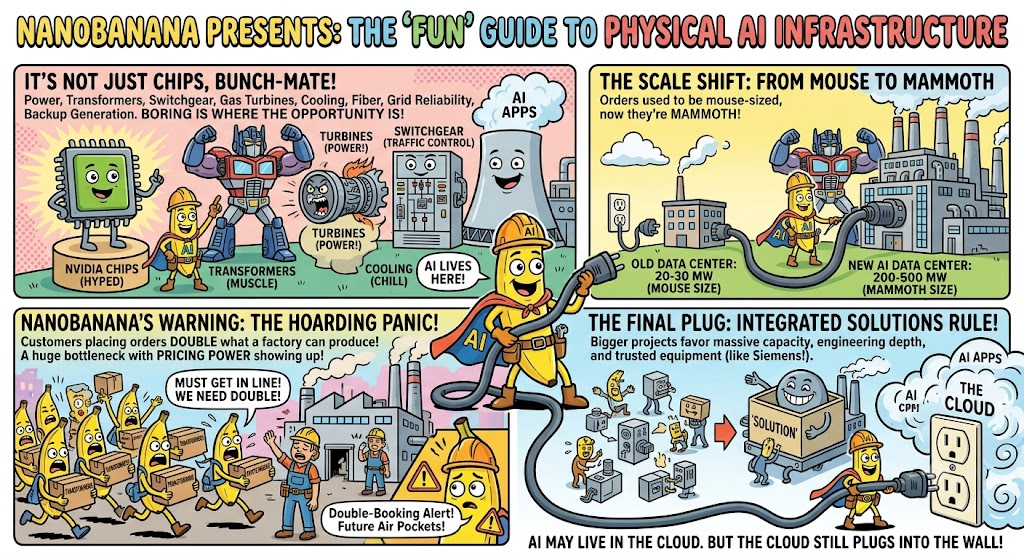
Power. Transformers. Switchgear. Gas turbines. Cooling. Fiber. Grid reliability. Backup generation.
That may sound boring, but boring is where some of the best opportunities have been hiding.
A recent interview with a Siemens AG (SIEGY) employee made this point clearly. This wasn't hype from a tech CEO. It was someone inside the energy equipment business saying demand has become shocking, even for people who've been in the industry for 40 years. Some customers are placing orders double what an entire factory can produce in a year.
That's not a normal business cycle. That's a bottleneck. And bottlenecks are where pricing power shows up.
You can see it in the public filings, not just the anecdotes. GE Vernova (GEV) just reported third-quarter orders up 55 percent and a total backlog of about 135 billion dollars. Its gas turbine book is so full that the company expects to approach 70 gigawatts of gas turbine commitments by year-end. For perspective, 70 gigawatts is roughly the entire installed capacity of New York and New Jersey combined. That's one company's order book.
The sales process has changed too. A few years ago, equipment providers had to make their case with emissions data, sustainability projections, and long presentations. Now customers just want the equipment. They want to get in line.
They know the backlog is long, and they know waiting could cost them years.
How long? Wood Mackenzie's latest survey pegs the average lead time for a large power transformer at 128 weeks. Generator step-up units run 144 weeks. That's two and a half to nearly three years.
Pre-pandemic, the same equipment shipped in seven to fourteen months. And prices on these units are up roughly 80 percent over the last five years. When buyers are willing to wait three years AND pay nearly double, that's not a soft market.
The scale shift is what matters most. Orders that used to be 20 to 30 megawatts are now 200 to 500 megawatts. That's a completely different animal.
Projects are getting bigger and more complex, so customers increasingly prefer integrated solutions over stitching together equipment from multiple suppliers. That favors companies with capacity, engineering depth, and trusted equipment.
In options terms, we need to respect both the theme and the price. The theme can be right and the stock can still be stretched.
That's why options are useful here. You don't have to chase every vertical chart. You can use defined-risk structures (trades where your maximum loss is capped before you put them on), sell premium when volatility gives you the opportunity, or wait for better entries in names tied to the grid, power equipment, and physical AI infrastructure.
One more point worth noting: a data center may need 100 megawatts, but the builder may buy more. They want backup units, N+1 reliability (a fancy way of saying "one extra unit beyond what we need so we never go dark"), and room to expand. They're planning for tomorrow's compute load, not today's.
That means the demand curve may be larger than most people expect.
There is one real caution. There's probably some double-booking in transformers and switchgear because lead times are so long. When customers panic about supply, they sometimes reserve more than they need. That can create future air pockets.
So this isn't a "buy anything with a grid story" market. But the bigger picture holds: the AI infrastructure buildout isn't a six-month story. It's a multi-year capital cycle.
If you want to get started, tune into the State of the Market tomorrow as I tell Mark about the three recent AI trades I made in Special Situations yesterday, and tease the big opportunities coming next.
Tap this link to join the State of the Market eLetter for a reminder tomorrow.
The software story may get crowded. The physical infrastructure story still has real legs.
AI may live in the cloud. But the cloud still plugs into the wall.
Here for a good time AND a long time,
Hans