

Yo Pit Crazies,
Now this is not the first time stocks have gone down. We’re only 3.5 percent from all-time highs. But there is a shift happening and it’s a big one.
In the first nine months of 2025, AI was good for everything. Remember Oracle Corp (ORCL) gapping up on spending $50 billion on AI? That stock hit $345 in September. Traders couldn’t throw money at AI fast enough.
In the first month of 2026, AI is bad for everything. Microsoft (MSFT) just dropped 10.5 percent in a single day, its worst since March 2020, after reporting record earnings. Revenue up 17 percent. Earnings up 60 percent. And the stock lost $357 billion in market cap overnight. Size losses on size numbers.
That’s the shift. Same spending. Same demand. Opposite reaction.
The $500 Billion Question Nobody Wants to Answer
Here’s what changed. Wall Street did the math. Big Tech is now on track to spend over $500 billion on AI infrastructure in 2026 alone, according to Goldman Sachs. That’s more than double the $237 billion they spent in 2024.
MSFT spent $37.5 billion in one quarter. That’s a 66 percent jump from a year ago. Alphabet (GOOGL) just guided $175 to $185 billion in 2026 capex. Wall Street expected $120 billion. The stock immediately dropped five percent despite beating on every line.
And ORCL? Down 47 percent from its September high. The poster child for AI hype turned into the poster child for AI doubt.
The market used to reward AI spending like it was free money. Now it’s asking the question every floor trader learns to ask early: when does this spending show up on the bottom line? The answer right now is nobody knows. And when traders don’t know, they sell.
I go on the Andrew market uncertainty rule: where there is general consensus and policy certainty, stocks rally. When traders are confused, stocks fall because the buyers go hide in a hole.
VIX Was Screaming. I Wasn’t Listening.
I was convinced this week that the big policy concerns were done. New Fed Chair, steady rate policy, some spending control from Washington. I traded as such. What I missed was the simplest indicator on the board.
VIX has not made a new low in 40 days.
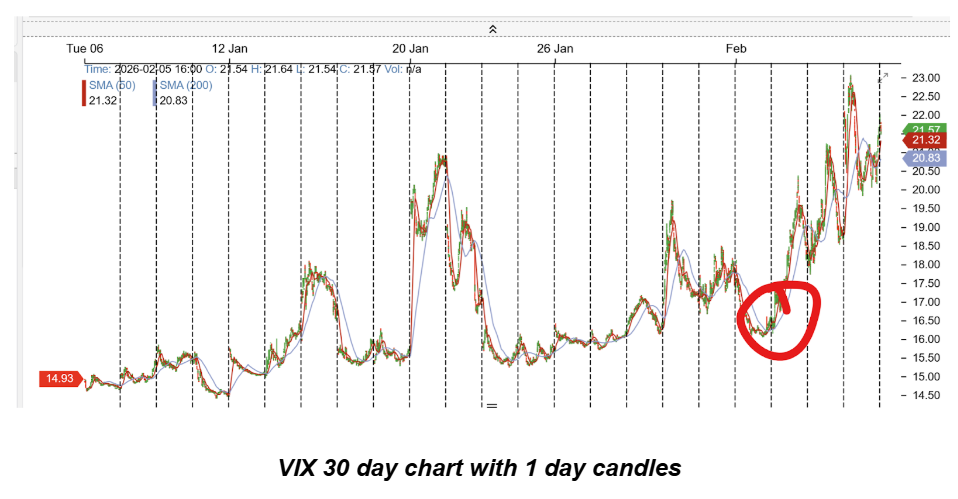
There was a fake out early in the week as SPY traded near all-time highs. Good earnings. Better Fed picture. But VIX kept climbing from its mid-January low to over 20 today while stocks were rallying. That divergence was the tell.
VIX should fall to previous levels when traders have confidence in the news. It didn’t. I had confidence in the news. The VIX did not.
On the floor we used to say “size” a lot. Size buyers, size sellers. The earnings picture is size. MSFT put up a 60 percent earnings jump. GOOGL crushed cloud revenue by 48 percent year over year. These are monster numbers. But the market is repricing what those numbers cost to produce. GOOGL has to spend $175 to $185 billion just to keep up, and the stock closed down on the day. Six months ago that capex number would have sent it up $50.
Your Move Before Friday
Here’s the takeaway. When VIX diverges from price, VIX wins. Every time. If you expect VIX to fall and it doesn’t, buckle up. Don’t fight it. I expected to close VIX puts Friday and that won’t be happening.
The fundamentals are good. Earnings are real. But the market needs a week or two for VIX to settle. I expect a short-term peak for VIX Friday morning that should chill after that. Until then, keep positions small, don’t chase the dip, and watch VIX, not headlines.
To Your Trading Success,
AG
RANT AND RAVE
Half a trillion dollars. That’s what Big Tech plans to spend on AI in 2026. Five hundred billion on data centers, chips, and cooling systems so a chatbot can write your kid’s book report. And the kicker? Not a single one of these companies can tell you when that spending turns into profit. MSFT’s gross margin just hit a three-year low. On record revenue.
Wall Street spent 2025 throwing confetti every time a CEO said “AI.” Now they want receipts. ORCL is down 47 percent because investors finally opened the credit default swaps page.
The market point: The AI trade isn’t dead. It’s just growing up. And growing up means VIX stays elevated until someone proves the math works. That’s your volatility tax for the next two weeks.