

Dear Trader,
Everybody's scared of this market.
And honestly? They should be, if they're still holding the same names they were holding two years ago.
Hans has been beating this drum since January: the AI trade isn't dead, it just moved.
The question is whether you moved with it.
This week he's got one stock he loves and one ETF he'd leave at the curb, and the logic behind both comes down to a single filter: can a chatbot replace it? If the answer is yes, Hans doesn't want it.
If the answer is "good luck prompting yourself a glass factory," he's in.
Here's Hans with his picks.

I know this market is scary. But only if you don't know where to look and what to steer clear of. What did I say two months ago on my OP Live special? That tech and Magnificent 7 stocks are going to have a very tough time this year. They're facing headwinds they haven't seen in decades. And that matters.
Here's one of my many bits of cautious commentary to Turbo Income members:
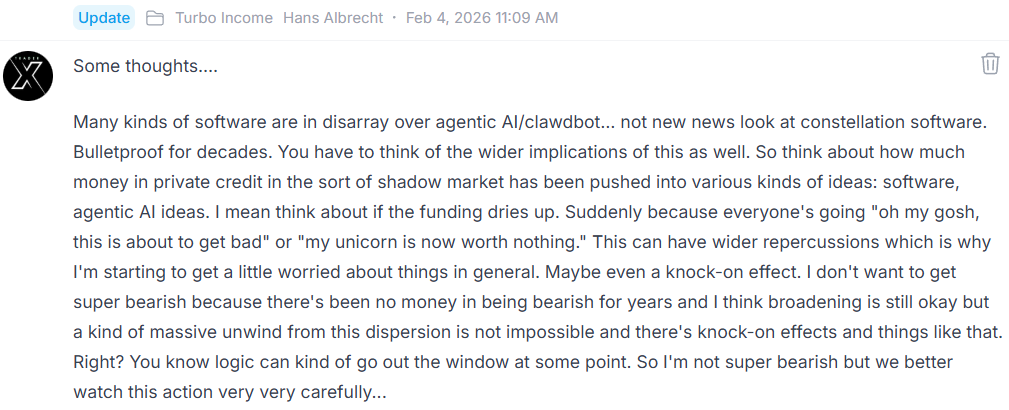
Here's March 4 where I tell members to watch XLF and HYG. Those were a big tell and have remained very weak:
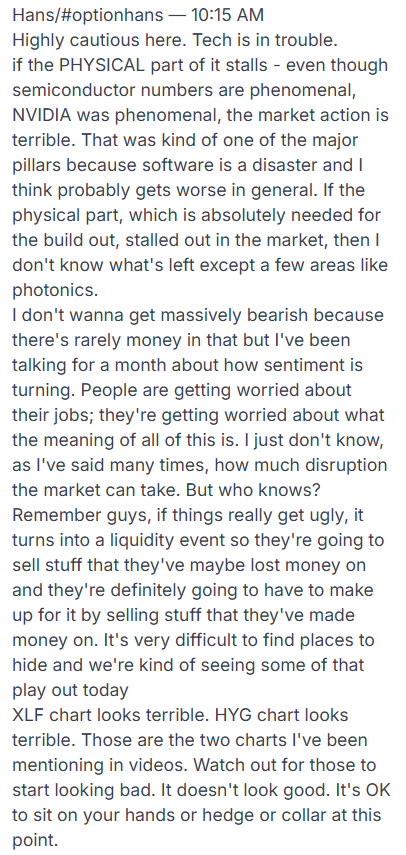
Is there opportunity elsewhere? You're darn tootin' there is, and I've been talking about those things. Turbo Income isn't some Pollyanna service that tells you to "think positive, the market will hug you if you love it hard enough." Nope, not my style. I'm too old to BS you guys.
I keep coming back to the same idea: the market's still underestimating how different the next phase of AI is going to look.
For years, the easy money was in software, platforms, and digital scale. Those businesses rode a beautiful wave: low rates, cheap capital, endless demand for code, and a world where creating digital products still required a lot of specialized humans. That world's changing fast.
The agentic age isn't just another software cycle. It's a threat to the old software and growth model itself.
When regular people and companies can increasingly generate what they need (code, workflows, tools, marketing, design, and eventually much more) a lot of the old toll booths start to look shaky. If something can be coded, copied, replicated, or replaced by intelligence on demand, its moat deserves a much harder look.
That's a big reason I like Corning (GLW)
GLW sits on the right side of the next buildout. If AI keeps scaling, if photonics becomes more important, if connectivity and data movement become more critical, then Corning is tied to something real, physical, and hard to replicate overnight. Fiber, optical components, advanced glass, materials science: this is the kind of backbone work that matters when the digital world collides with real-world constraints. Compute demand is going to be exponential. We're going to have to move that data around faster.
This is the kind of company that fits my "stuff I can drop on my toe" framework.
You can't prompt your way into a bag of cement. You can't AI-generate fiber infrastructure. You can't wish advanced materials into existence without factories, process, engineering, and physical execution. The world may be getting more digital, but that only increases the importance of the physical layer underneath it.
That's why GLW makes sense to me as a "one to love."
Now for the one to leave Vanguard Mega Cap Growth ETF (MGK)
MGK is basically a basket of the old winners: the names that benefited most from the era when growth could keep stretching, software could keep eating the world, and scale itself was treated like an invincible moat.
I think that regime's breaking down.
The tailwinds that powered mega-cap growth are fading. The old assumptions around recurring digital revenue, software pricing power, and endless multiple support aren't as secure as they looked. When intelligence becomes cheap, abundant, and embedded everywhere, the value shifts. Some incumbents will adapt. But many pieces of the old growth complex are much more vulnerable than people want to admit.
To me, MGK represents the part of the market that still hasn't fully priced in that risk.
This isn't just about valuation. It's about business model pressure. It's about disruption moving upstream into the very companies investors once believed were the disruptors. It's about a world where creation is cheaper, barriers are lower, and customers have more options. That's great for society, but it's not always great for mature growth companies living off old economics.
So my pair is simple:
Love GLW: the photonic and physical infrastructure layer matters more in the AI age. Leave MGK: growth, especially software-heavy growth, is losing the tailwinds that carried it for years.
That's the shift I see.
Less fantasy. More physicality. Less code premium. More real-world constraint. Less paying up for old digital toll booths. More owning the picks, shovels, and pipes of the next era.
That's where you can find comfort in this market: in the high-value confidence of things we can't live without as the world re-tiles for AI-in-everything.
Here for a good time AND a long time,
Hans
Hans just drew you a line in the sand. On one side: stuff you can hold, bend, and run light through.
On the other: a basket of names still priced like it's 2021. Whether you agree with the specifics or not, the framework is worth stealing. Physical versus promptable.
That's a filter you can use on every single name in your portfolio.
Speaking of picks: tune in Monday at 10:30 AM ET when the whole team goes live on the Ticker Highlight Show to break down what they're watching this week.
Tap this link to join before the bell rings.
See you there,
Charles Delvalle
Managing Editor, Option Pit