

Dear Trader,
Split a hundred thousand dollars evenly between the two index funds sitting in almost every retail brokerage account in America, and you'd think you owned hundreds of companies. You'd really have about $41,000 riding on nine of them.
That's what's been bothering me for a couple of years now. The pool of stocks that actually matters keeps shrinking, and index funds are the reason.
Here's the math. NVIDIA (NVDA), which reported Wednesday night, is 7.8 percent of the SPDR S&P 500 ETF Trust (SPY) and 8.2 percent of the Invesco QQQ Trust (QQQ). Split your money evenly between the two funds and roughly eight percent of everything you own is one company.
Now look underneath. Nine of the top 10 holdings in those two funds are the same nine names. QQQ's tenth slot goes to Advanced Micro Devices (AMD) and SPY's goes to Eli Lilly (LLY), and that's the entire difference.
Those nine shared names are about 45 percent of QQQ and about 37 percent of SPY. On $50,000 in each, you're looking at roughly $41,000 in nine companies. You never picked a single one of them.
So I asked Option Pit's macro guy and my good friend Tim Colby a question: is SPY becoming obsolete?
Look at how the two indexes have tracked each other.
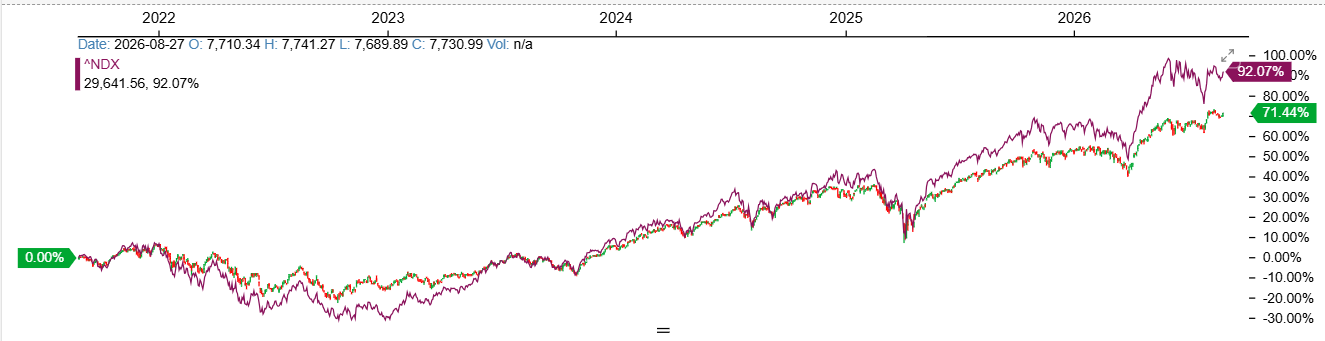
They move together. The S&P 500 doesn't fall as hard in a selloff, but that's because it doesn't climb as fast in the rally that came before it. Stretch the window out and the Nasdaq's extra gains have more than covered its deeper drawdowns.
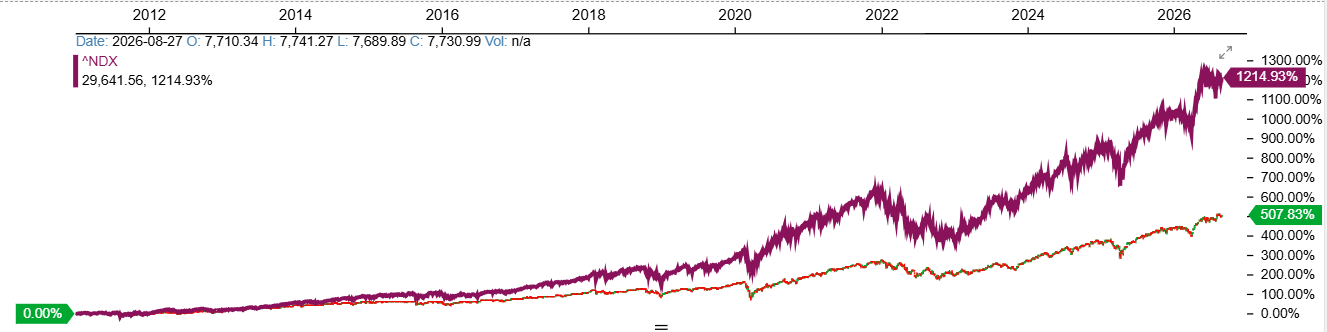
Why own the S&P if all you're getting is a watered-down QQQ?
Thursday made the point better than either chart does. Nvidia jumped almost nine percent on its number and dragged the S&P 500 higher on its own. The equal-weight version of those exact same 500 companies traded lower on the day.
If you want to be heavy tech, own QQQ and know that's what you're doing. If you want the broad market, I'd argue equal weight is the better call. The Invesco S&P 500 Equal Weight ETF (RSP) holds the same 500 names in the same dollar amount at the start of every quarter, then rebalances, selling whatever ran and buying whatever lagged.
I'll be straight about the trade-off, because the last decade hasn't been kind to this position. Over 10 years RSP has returned about 12 percent a year against roughly 15 percent for SPY. Every stretch the mega-caps led, cap weighting won.
This year has gone the other way. RSP is up about 17 percent against roughly 13 percent for SPY, and it's gotten there with noticeably less day-to-day movement. On a risk-adjusted basis over the past 12 months, it's ahead.
Equal weight has been my S&P exposure for several years. I hold some of both, so I get the tech and I get the actual broad market.
There's another answer, and it's the one Tim gave me when I asked.
His Macro Gauntlet scores the macro picture and tells him which sector ETFs to own on momentum and which ones to leave alone.
If you'd rather own shares than index funds, his system has delivered a far better Sharpe ratio than sitting in the index.
If you trade options on top of it, the numbers get more interesting. Since he started trading it live in May, he's 13 times the S&P over the same stretch.
You can see how the Macro Gauntlet works here.
Your only option,
Mark Sebastian