

Hi Traders,
Someone shopping for a camera visits about five websites before they buy.
An AI agent doing that same job visits 5,000.
Matthew Prince used that comparison at SXSW in March to explain a milestone he thought was still a year or two away. It showed up in June instead.
On June 3rd, Prince posted that bots had passed human traffic online for the first time in the internet's history. Automated requests now make up 57.5 percent of HTTP traffic to web content. Humans make up 42.5 percent.
He'd called that crossover for the end of 2027, then moved it up to early 2027. It landed about 18 months ahead of his own estimate. Cloudflare (NET) routes roughly a fifth of global web traffic, so its Radar data is about as close to a census as anyone gets.
Now look at what's driving it.
In its second-quarter investor deck, Cloudflare reported daily AI agent requests up more than 1,700 percent year over year as of May 31. Crawlers and scrapers have been around for 30 years and never produced a number like that.
Agents work differently. They browse on your behalf, fill forms, compare options and call APIs at machine speed off a single request from one person. Every one of those requests lands on a server that got provisioned for somebody clicking a mouse.
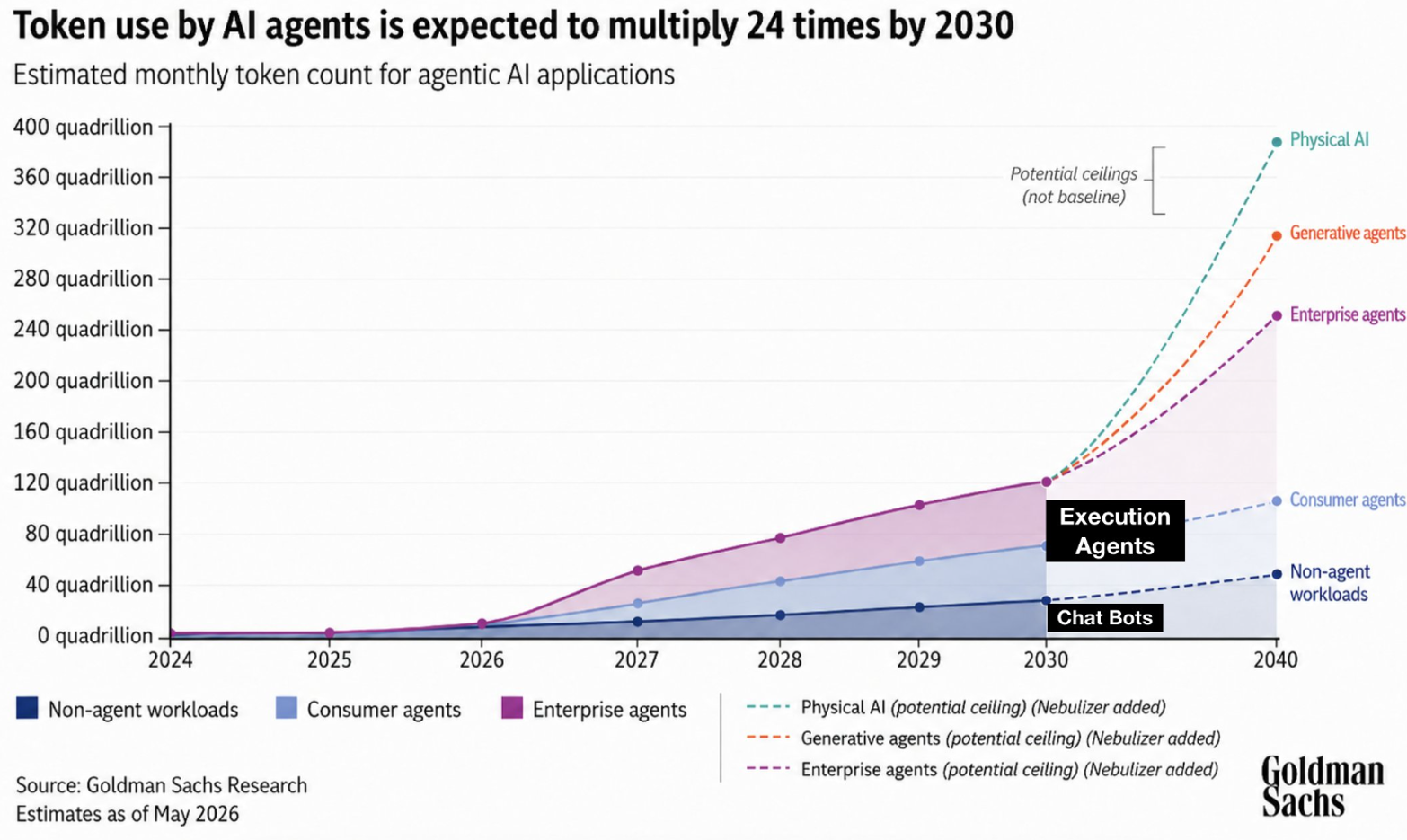
Goldman Sachs put a figure on where that goes. Analyst Jim Schneider expects global token consumption to multiply 24 times between 2026 and 2030, from roughly five quadrillion tokens a month to 120 quadrillion. By 2040 he has it at 55 times today's level, with enterprise agents accounting for more than 70 percent of the total.
The chatbot is a rounding error in that forecast. You asking ChatGPT a question and getting an answer sits along the flat bottom of the curve. Almost all the growth comes from agents that never stop working, whether that's an enterprise system grinding through hundreds of contracts overnight or a consumer agent checking 40 airline sites while you sleep.
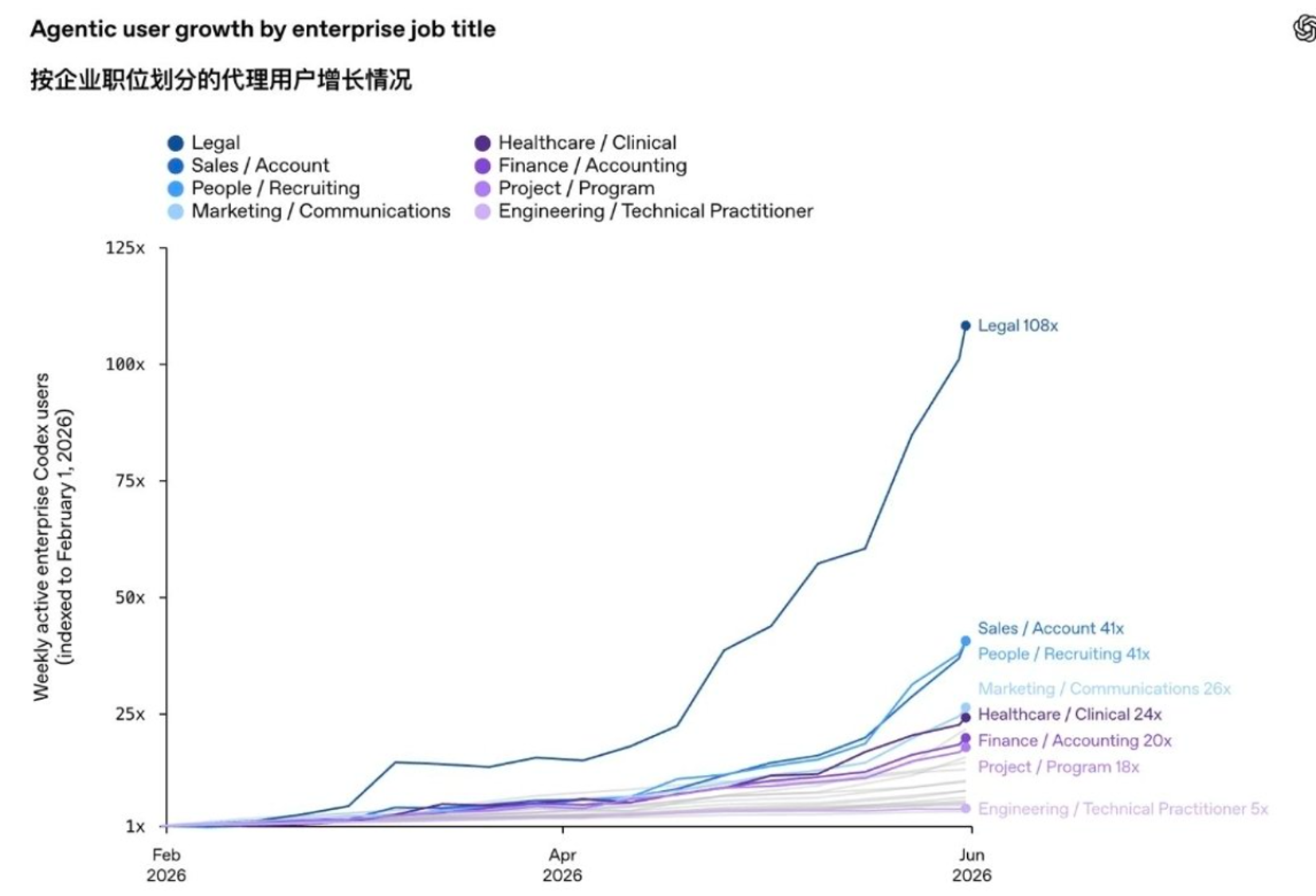
OpenAI's Enterprise Signals data, published in August, shows who's actually doing this. Weekly active enterprise Codex users since February: legal up 108 times, sales up 41 times, recruiting up 41 times, marketing up 26 times, health care up 24 times. Engineering, the group that built these tools, is up five times.
Those multiples come off a near-zero base, so 108 is direction rather than headcount. Legal and recruiting had almost no agent usage in February and they're running agents daily now. Nobody in either seat is planning to run fewer next quarter.
OpenAI also reported that by June, Codex generated 64 percent of the combined Codex and ChatGPT output tokens its enterprise customers produced. Most of what companies get out of OpenAI now comes from delegated work rather than conversation.
Here's the part the charts leave out: The physical plant underneath all of this has lead times measured in years.
Before 2020, a utility transformer took 24 to 30 months to deliver. Today that queue runs three to five years. In several major U.S. markets, a new grid connection can take longer than seven years.
Bloom Energy's 2026 power report puts U.S. data center IT load near 80 gigawatts in 2025 and headed for roughly 150 gigawatts by 2028. The Department of Energy figures the grid needs 100 gigawatts of new capacity by 2030, about half of it for data centers. Boston Consulting Group has the shortfall running past 45 gigawatts.
Agent demand compounds on a monthly clock. The generation, transmission and electrical equipment that has to carry it compounds on a decade clock. Capital chasing that gap has to land somewhere.
Somewhere is the operative word. This buildout doesn't sit in one sector. Money moves through semiconductors, then power producers, then utilities, industrials and the companies making switchgear, and it rarely stays anywhere long.
Knowing the buildout is real is the easy part now. Knowing which sector is absorbing the money this month is the hard part, and that's the question Tim Colby built the Macro Gauntlet to answer.
He's showing it live this Thursday, August 27th at 7 PM ET, alongside Hannah Selner. He'll walk through how he finds where capital is rotating, what clears his criteria, and what he's watching right now.
Time to get strategically greedy.
Here for a good time AND a long time,
Hans