

Hi Traders.
I keep three charts side by side and have since 2013.
Yen futures, VIX futures, and the 30-year bond.
They don't just look alike. They go up on the same days, in the same hour, often in the same few minutes. A Japanese currency, a stock fear index, and a U.S. government bond should have nothing to do with each other.
Last Thursday night they came apart.
The yen went from about 164 to the dollar to 157.96 in a little over an hour. That's close to a 3 percent move and the dollar's worst session since late 2022. Japan was buying its own currency, and U.S. authorities ran a rate check on the way in, which is how Washington signals it might join.
Stocks barely noticed. They finished the week near record highs.
So my fear gauge went off and there was no fear. To see why that matters, you have to see what the yen actually measures.
The Cheapest Loan on Earth
Imagine you can borrow at 1 percent. Not a teaser rate. That's just what money costs where you live.
You take that money, change it into dollars, and buy U.S. Treasury bills paying close to 4 percent. You pocket the difference for doing nothing at all. No skill, no timing, no opinion about anything.
That sounds made up. It's the yen carry trade, and it's been running for 30 years. The Bank of Japan pays 1.00 percent, the Fed pays 3.50 to 3.75, and that 275 basis point gap is the whole engine.
Here's the part that turns it into a business. You don't have to live in Japan to do this. Big firms borrow 10 or 20 times what they actually have, so 2.75 percent becomes 27 or 55.
In Japan it's a household thing. They even have a nickname for it, Mrs. Watanabe, which is about the same as saying Mrs. Smith. In a lot of Japanese homes the wife runs the money and hands the husband an allowance, and when regular people got currency trading on margin, housewives started running this from the kitchen table.
Same trade a hedge fund in Connecticut runs through a big bank. Different kitchen.
The catch is that the loan is in their money. If the yen goes up 5 percent, you owe 5 percent more. Months of yield gone in an afternoon.
Why It's Really a Bet on Calm
Nobody borrows yen to sit in T-bills. They borrow yen and buy things that pay more. Stocks, company bonds, whatever has yield.
So picture the account: On one side, the stuff they bought. On the other side, a loan they owe in yen.
Now the market drops.
The position is bought with borrowed money, so a small move in the asset is a large move in the account. When markets get jumpy, traders trim. When markets get ugly, the margin desk trims for them.
And it doesn't cut one thing. It cuts everything at once. Sell the stocks and the VIX goes up, then buy Treasuries to keep the carry on or buy back yen to close the loan entirely.
That's why my three charts move together. It's one trade unwinding in a hurry.
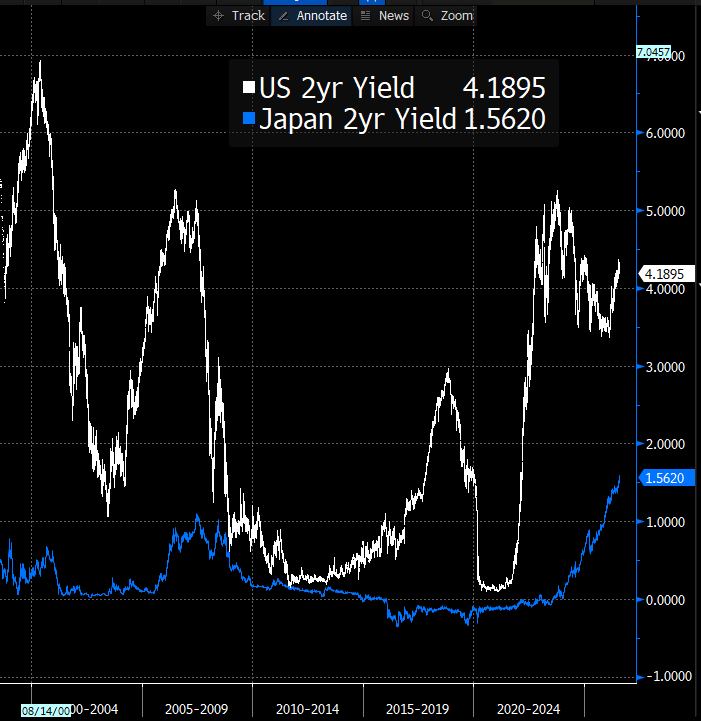
Three Markets, One Trade
Riding it out isn't an option either. The trade earns maybe 2.75 percent over a full year, call it a penny a day, and a 2 percent yen spike wipes out nine months of pennies before lunch.
When a Currency Starts Trading on Groceries
Which brings us back to Thursday, and why it looked like none of that.
Japan buys almost all its energy and pays for it in dollars. That's where a weak currency stops being an economics debate and starts being groceries.
Think about it…
In 2021 a barrel of oil cost Japan about 7,800 yen. At last month's peak that same barrel ran north of 16,000. More than half of that jump is from a currency losing value.
You can see it in their books. In June, fuel imports rose 42 percent, and Japan ran a trade shortfall of 407 billion yen against a surplus the year before.
They can't fix it with rates. Japan owes roughly 240 percent of what the whole country earns in a year, and debt service alone hits a record 31.3 trillion yen this fiscal year, about a quarter of the budget.
Every hike raises those interest payments.
So they buy the currency instead. They spent 11.7 trillion yen doing exactly that across late April and May, about 73 billion dollars and the largest month on record. It bought them four weeks.
Thursday was the next round. And the normal way a country funds that is by selling U.S. government bonds.
But these aren’t normal times.
Later this week I’ll tell you all about it.
That's part two.
One more thing before I go…
I track these big picture movements because they reveal short-term movements to trade options on.
I’m working on a trading strategy that incorporates macro shifts to make short-term money using options.
I’ll tell you more about it as we get closer to launch.
Enjoy the process,
Tim