

Hey Income Traders,
Take a good look at this chart. In 30 years of trading, I've rarely seen price and earnings split this wide.
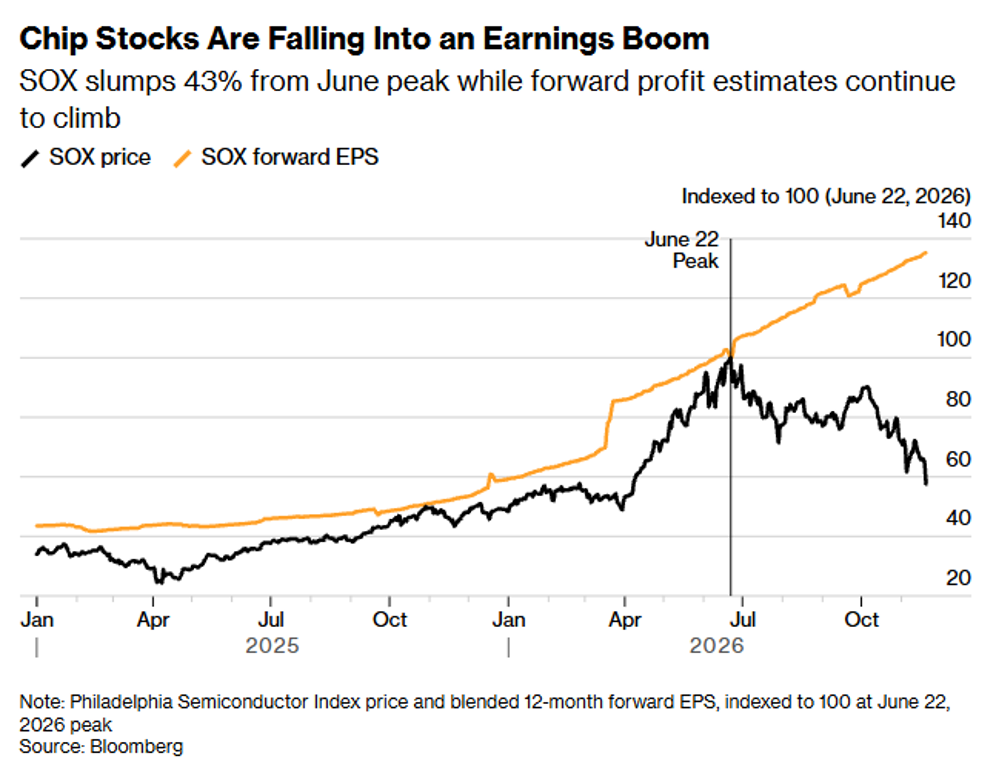
The black line is the Philadelphia Semiconductor Index. It's down 43% from its June 22 peak. The orange line is what Wall Street expects those same companies to earn over the next 12 months. It hasn't blinked. It's up about a third since June and still climbing.
Price down 43%. Earnings estimates up about a third. Do the math and the multiple on the chip group has been cut by more than half in five months.
Bank of America had the SOX near 10 times two-year forward earnings earlier this month, the cheapest since 2011. That was before last week, when Nvidia fell 23% (its worst week since October 2008) and Taiwan Semi fell 20% (its worst since 2002). Nvidia, Micron, Marvell, CoreWeave and Nebius each dropped more than 20% in five days.
So chips are cheap. The question is whether they're cheap or just look cheap.
The market is saying the E is wrong
When price and earnings estimates split this hard, my first instinct is that somebody's wrong. And it's usually the analysts.
Chips are the most cyclical group in the market. The old saying goes: buy semis when the P/E looks expensive, sell them when it looks cheap. Cheap multiples tend to show up right at peak earnings, just before the estimates roll over. Price moves first. Analysts are the last to cut.
So I take this chart seriously. The market's telling you it doesn't believe the orange line.
Where I come out: it slows, just not much
I think the E is probably a little too high. I don't think it's anywhere near as wrong as the price says.
JPMorgan put out its 2027 outlook this week, and their strategists landed where I've been for weeks. They say the AI supercycle is intact, with demand for compute "still strong and sticky." They also say demand is a multiple of what current supply can serve, and that bottlenecks and de-ratings like this one fit an adoption curve that's still steepening.
They even expect earnings growth to slow. For the S&P overall, JPM sees growth coming down from about 35% this year to around 17% next year. Slower. Still huge.
That's my view on chips too. Demand isn't the problem. The bottlenecks are physical and financial: power, buildings, permits and money. When a data center can't get built on time, chip orders get pushed out. That shaves the E. It doesn't erase it.
Now run the numbers off the chart. If chip earnings estimates got cut by a full quarter tomorrow, the group would still trade more than 40% below its June multiple. The price is discounting something a lot worse than "slower."
What could make me wrong
Rates. JPM says the biggest risk to its own call is higher rates, and it expects the Fed to hike three times before April. Rising yields and wider credit spreads hit the buildout where it's weakest: the financing. If projects can't get funded, the E gets cut harder than I think.
And not every chip name is the same chip name. Nvidia has company-specific problems right now, and I'm leaving it alone. I want companies that own a real bottleneck, where demand outruns supply no matter whose data center gets built.
How I'm playing it for income
This setup pays you to sell fear. Leave the lottery tickets alone.
1. Wait for the VIX to crest. Don't sell premium while vol is still climbing. When it rolls over, that's your window.
2. Sell downside, with defined risk. Put spreads on quality chip names with real earnings, at strikes where you'd be happy to own the stock. Inflated put premium pays you to wait. The spread protects you if the E really does crack.
3. Already own chips? Don't dump them at a 43% discount. Vol is high, so covered calls pay well, but sell them further out of the money than usual so a snapback rally doesn't get capped.
4. Size small. A cheap stock can get cheaper. Keep dry powder to add if this gets uglier.
Bottom line
The chart says the E is wrong. I think the E is just early. Growth slows, demand stays, and a group that just lost more than half its multiple doesn't need perfect news to work. It just needs news that's less bad than the price.
That's a good spot to be getting paid.
Hans Albrecht
Head of Income, OptionPit