

Hey Income Traders,
Take a look at this chart.
Fintech accounts pay between 3.3% and 5% on deposits these days. The FDIC's national average for a savings account sits a little under 0.4%, and interest checking pays 0.07%.
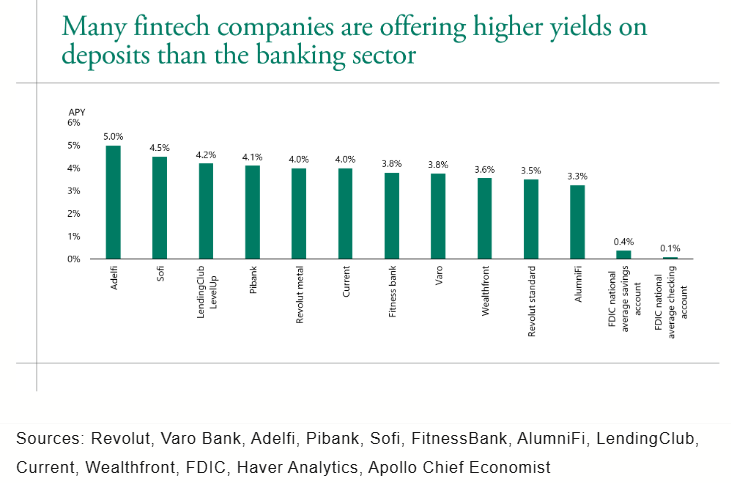
Apollo's chief economist, Torsten Slok, ran that chart Sunday in a note titled "Is an Agentic Bank Run Coming?" The gap has sat in plain sight for years because moving money feels like a chore, and most people either don't know it exists or can't be bothered to close it. Banks built an entire funding model on that shrug.
Now picture every household with a 180 IQ in its pocket that never gets bored, never forgets, and works for pennies while you sleep.
It spots the gap, fills out the transfer form and moves the money before you've finished your coffee. Multiply that by a hundred million households and the cheapest deposits in the banking system head for the exit.
Slok's worry is lending, since banks fund loans with those cheap deposits. He wrote that if every household let an agent manage its cash, banks "could lose a large share of the cheap deposits they rely on." Bank of America analyst Ebrahim Poonawala flagged the same risk, warning that agentic AI "erodes the customer inertia underpinning low-cost deposits."
Fair enough, but deposits are the small version of this story. This economy collects an enormous amount of margin purely from inattention. Think about the insurance renewal nobody shops, the phone plan nobody switches, the fee schedule nobody reads and the freight lane nobody puts back out to bid, each one charging you a toll for not paying attention.
We've even seen the size of one of those tolls. Britain's Financial Conduct Authority found that in 2018, six million loyal home and car insurance customers paid £1.2 billion more than their actual risk called for, mostly by renewing year after year without shopping around. It took a regulator and a new rulebook to close that gap in one market in one country.
Agentic AI is an attention machine. It'll go hunting for that kind of gap everywhere, and it won't wait on a regulator. I call what comes next process yield destruction (the profit that vanishes once somebody finally notices the waste).
The damage lands on the middle layer. The producer keeps making the product, and the consumer keeps more of her paycheck. The guy in between, who made his living off the spread, eats the loss.
All of that optimizing runs on inference (the computing power an AI model burns every time it works through a task). Every rate check, renewal, switch and negotiation an agent handles for you costs compute, and somebody pays that bill.
Token prices keep falling, and plenty of people read that as demand destruction. They've got it backwards. Stanford's AI Index found the cost of running a GPT-3.5-level model dropped from $20 per million tokens in late 2022 to seven cents by late 2024, roughly 280 times cheaper.
Cheap tokens let an agent run a thousand checks instead of one. Every one of those checks needs memory to run on, and that's why memory prices haven't stopped climbing. TrendForce expects server DRAM (the short-term memory AI servers use to hold data while they work) contract prices to rise another 13 to 18 percent this quarter.
You can see it in the numbers at Micron (MU). It booked $41.5 billion in revenue last quarter, up from $9.3 billion a year earlier, and guided to about $50 billion for the quarter it reports after the bell Wednesday.
That report matters more than the headlines will admit. It'll show whether all those cheap tokens keep turning into orders for memory.
Here for a good time AND a long time,
Hans