

Dear traders,
The Health Care Select Sector SPDR (XLV) is firm, and the Industrial Select Sector SPDR (XLI) looks like death.
Barchart put out a chart showing the highest share of negative-beta stocks in the S&P 500 in history.
That's stocks moving against the index at a rate nobody's seen in data going back to 1990, and it's a sign to look inside the sectors.
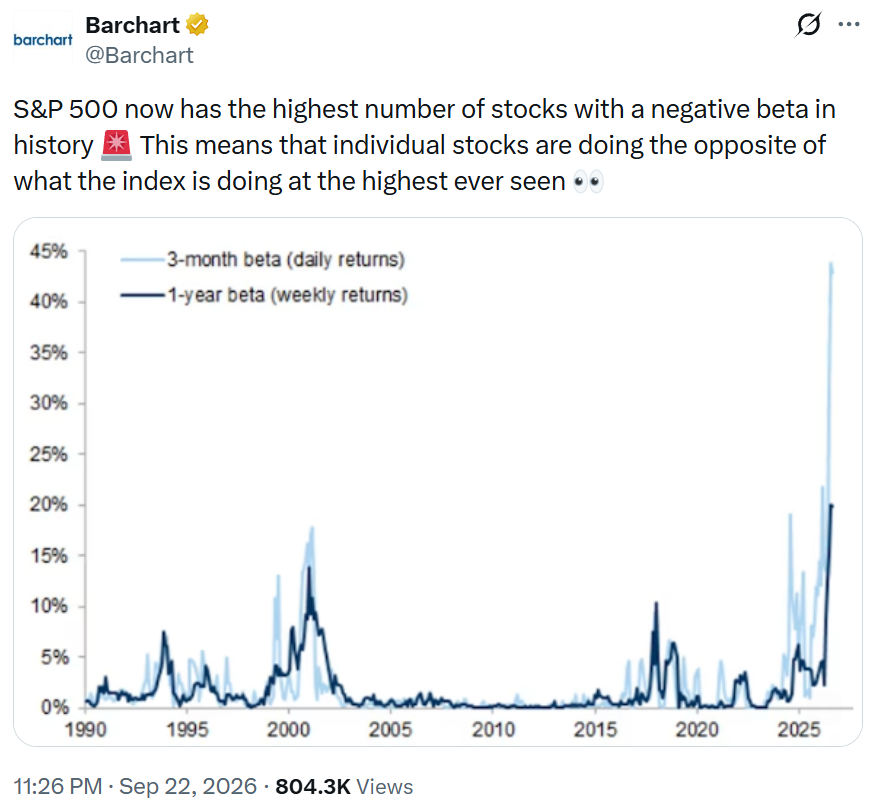
When this many names stop moving with the index, you can't learn much from the index number. So I looked into both sectors and found the same split in each.
My love sits right behind the biggest winner in pharma, with a date circled for late October. My leave dropped on good news this week, and I don't think that's an accident.
I run a watchlist that ranks every name in a sector by how far it moved on the day, the week, and the month, adjusted for how much that name normally moves. Sort it and the groups sort themselves.
Healthcare splits into three stories. The companies that run the experiments are getting bought: Thermo Fisher Scientific (TMO), Agilent Technologies (A), Charles River Laboratories (CRL), and Natera (NTRA). The day Anthropic said its AI found a new enzyme, the lab-tools names ripped.
AI can find the molecule, but it can't run the experiment. Even Anthropic had its own scientists do the lab work.
Pharma splits too. Pfizer (PFE) and Eli Lilly (LLY) are getting bought, and Bristol Myers Squibb (BMY) is flat. The companies that insure the patient or sell into the hospital are getting sold: UnitedHealth Group (UNH), CVS Health (CVS), Abbott Laboratories (ABT), and Stryker (SYK).
Industrials split the same way. The data center's getting built, and Eaton (ETN), Hubbell (HUBB), Quanta Services (PWR), and Vertiv (VRT) are green while the sector's red. Defense is unwinding on the Iran peace headlines.
And freight is broken. Union Pacific (UNP), CSX (CSX), Norfolk Southern (NSC), PACCAR (PCAR), and Old Dominion Freight Line (ODFL) are red on every window. Diesel just hit a record six and a half bucks a gallon, real GDP grew 1.5 percent last quarter, and the bottom half of the economy isn't shipping anything.
Same story in both sectors. The market's paying for what gets built next and selling what moves stuff around now.
Here's the rule I use once the groups sort out. The strongest and weakest names tell you which way the group's going. They're the tell, not the trade.
The trade is the one at the edge, the name that hasn't made its move yet.
Love: Merck's Date in Madrid
The market's paying for the next molecule on both ends. On one end, it's the small biotechs I covered last week, the ones where the whole company is the bet. On the other end, it's the mega caps, where the bet is one drug inside a big business and the rest of the business pays you to wait.
Merck (MRK) is the second kind.
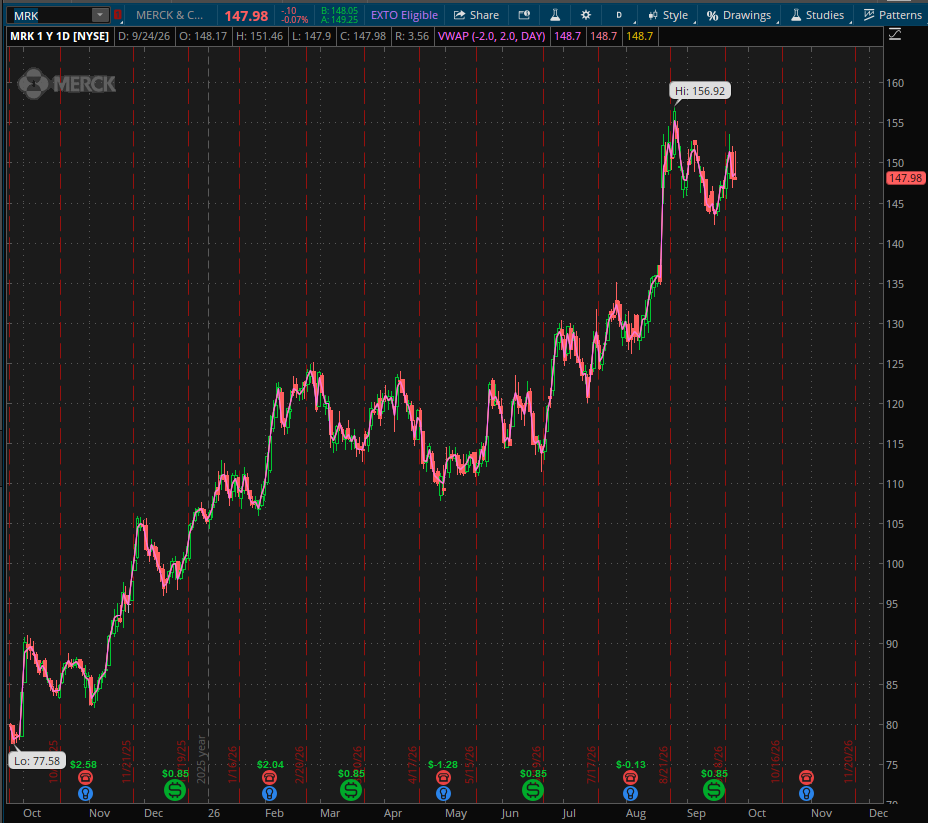
Pfizer and Eli Lilly already pulled back and turned up, and Moderna (MRNA) went up 177 percent in a single day on the same melanoma data Merck reported. Those are the strongest names in pharma, and they're the tell. Merck went up 12.6 percent on that news and has been flagging (drifting sideways in a tight range after a big jump) ever since.
It's the edge.
Merck's where the flows land, and it comes with a calendar. It gapped up (opened well above the prior close) on August 19 on positive Phase 3 melanoma data for the cancer vaccine it's building with Moderna. It's spent the month since going sideways just under that high, with higher lows the whole way, holding well above the gap.
The stock's up nearly 80 percent over the past year and close to 40 percent in 2026, so this isn't a bottom fish, it's momentum resting.
The full data comes at the ESMO cancer conference in Madrid, October 23 to 27. The melanoma trial landed a slot in the Presidential Symposium on October 24, the conference's main stage, and there's a run of FDA decision dates between here and there. That's the reason the flag exists.
The market's waiting.
There are places to buy inside momentum. A one-month flag on top of a data gap, with the next catalyst dated, is one of them.
The risk is the one every Merck holder knows. Keytruda brought in about half of Merck's sales last year, and it loses U.S. patent protection in 2028, which is exactly why the vaccine data is the whole story. If the flag breaks down through the gap before ESMO, the market's telling me the data won't carry it, and I'm out.
Leave: The Rally That Never Left the Station
Pull up Norfolk, CSX, and UNP and you're looking at the same chart three times. All three broke down, all three bounced, and none of the bounces have anything behind them. Freight is broken, and the market isn't done pricing it.
That's the theme, and I think it keeps going.
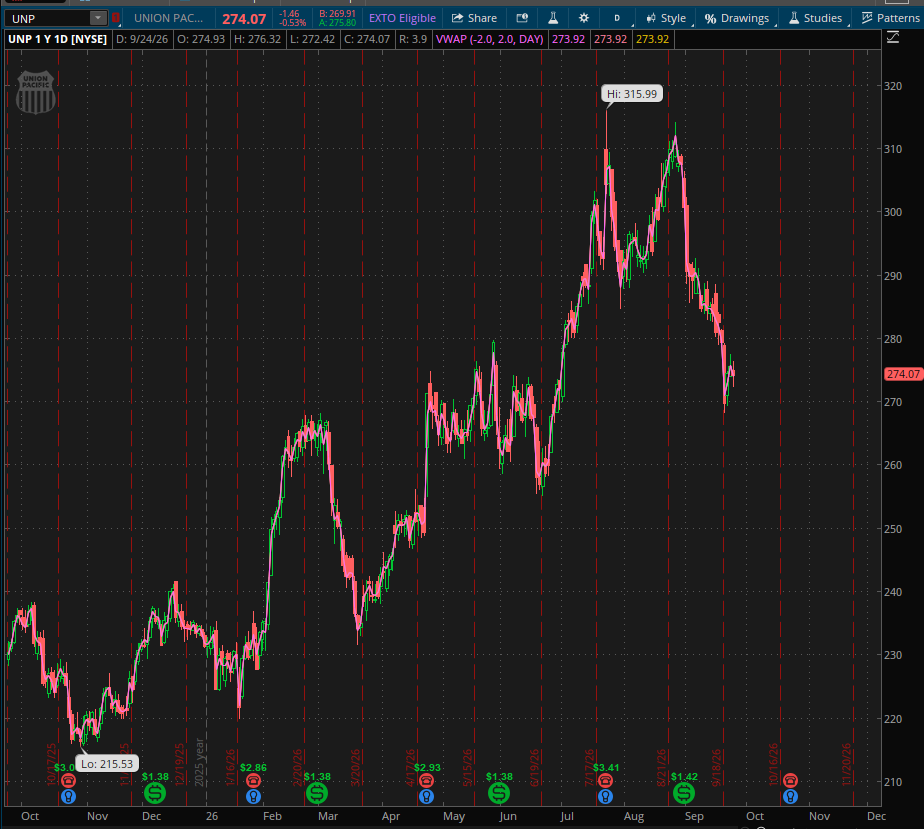
UNP is the one I'm selling. It ran from 215 to 316 and gave the whole summer leg back. It's sitting on the level it broke out from in June, under a falling moving average (the line tracking its average price), and the bounce off the low was a couple of points on tight bars (small, quiet trading days).
Then there's the deal.
UNP is buying Norfolk Southern for $85 billion, and last Friday the STB (the regulator that has to approve it) threw out the rivals' motions to kill the review. That's good news for the deal.
The stock fell 3.5 percent on Monday while the S&P 500 gained 1.5 percent. When a name can't rally on its own good headline, it's trading on something else, and that something else is freight.
Swing short (a bet on the stock falling over the next few weeks) for a new low.
That rule about the edge is how I trade every group. The biggest movers show you where it's heading, and the money's in the name that hasn't moved yet.
That's the kind of setup we hunt for on the Ticker Highlight Show Premium every Monday at 10:30 AM ET. We walk through our picks live and settle on the trade we'd actually take. Merck's data hits the stage in Madrid in four weeks, but the next setup lands a lot sooner.
Tap this link to join the Ticker Highlight Show Premium before Monday.
Enjoy the journey,
Tim