

How many “bad beats” does it take for something to become a “bad strategy”?
JPMorgan’s Hedged Equity Fund (JHEQX) just had another rough quarterly roll. Some people called it a bad beat. I disagree. This is just a bad strategy.
Mark agrees. He wrote about the messy mechanics yesterday. I want to ask a bigger question. Forget this quarter. Is this strategy even worth owning?"
It’s not only JPM, there is a bunch of investable nonsense out there like this. You should know how to spot it.
Let’s take a look at the last 12 years of this “hedged equity” gem that has 20 billion dollars sitting in it. And because the restaurant analogy I used for private credit gave me chuckle, let's use another one.
The Chef's Special
You go to a well-known steakhouse. Your buddy orders the ribeye. The waiter leans in. "May I recommend the Chef's Curated Wellness Tasting Experience? Designed to deliver the steakhouse experience with built-in health protection. Reduced calories. Optimized nutritional exposure."
You're like, "What?" The waiter is pushy, so you order it because you trust the name on the door.
Then the plate arrives. It's a smaller piece of the same steak your buddy got. With garnish on top. And the bill is higher.
That's the JPMorgan Hedged Equity Fund. There's $20 billion on that plate.
Reading the Nutritional Label
Look at this word salad of a description
“The Fund seeks capital appreciation. The Fund participates in the broad equity markets while hedging overall market exposure relative to traditional long-only equity strategies. The Fund uses an enhanced index strategy to invest in these equities, which consist of common stocks of large capitalization U.S. companies”
Try this instead. “We buy the S&P 500, and some put spreads, and sell some calls. Oh yeah, and we underperform on every metric that actually matters.”
The S&P 500 is the steak. They buy put spreads to protect the downside. That costs money, so the steak gets smaller. Then they sell upside calls to pay for it. That cuts off your upside and makes the steak even less filling.
The chef took a perfectly good ribeye, trimmed it down, dressed it up, and sold it as a "Curated Wellness Experience."
Don't get me wrong. Collars and risk reversals can work depending on your needs. If you have individual stock risk and need protection, it's a solid tool.
But as a long term alternative strategy to the S&P 500? No. All that protection costs money. I wrote here, why the S&P is a great index. It doesn’t behave like an individual stock.
Let’s do some math.
Historical returns are like a nutrition label. I actually look at strategy returns in reverse order. I skip past the return and I look at the risk first.
If someone tells me about a strategy that averages 10 percent per year, the first thing I ask is how much does it lose.
Divide the upside by the downside. That’s the risk-adjusted return. That's the nutrition label.
When leverage or options are involved, it's the one number that matters more than anything. It tells you whether the Chef's Special is actually healthier or just junk food with a fancy name.
I pulled all 12 years of data for this Fund. April 2014 through April 2026. Every major correction this fund was supposed to protect you against. Here's their nutrition label.
That looks great on the surface. It cut the losses. You only had to stomach 65 to 75 percent of the worst indigestion the SPY gave you.
Until you consider the cost.
Over those 12 years the S&P 500 averaged about 13 percent. The Chefs Special? 6.8 percent. That’s 1.9 to one.
The compounded return is way wider. 328 percent vs The Chef's Special 125 percent. That’s 2.5 to one.
Now the important part. When you run the risk adjusted returns, average return divided by risk, the table completely flips.
Let’s be generous to give this a fighting chance. Let’s use the non-compounded returns. Because compounding, as you’ll see in the cart below, blows this away.
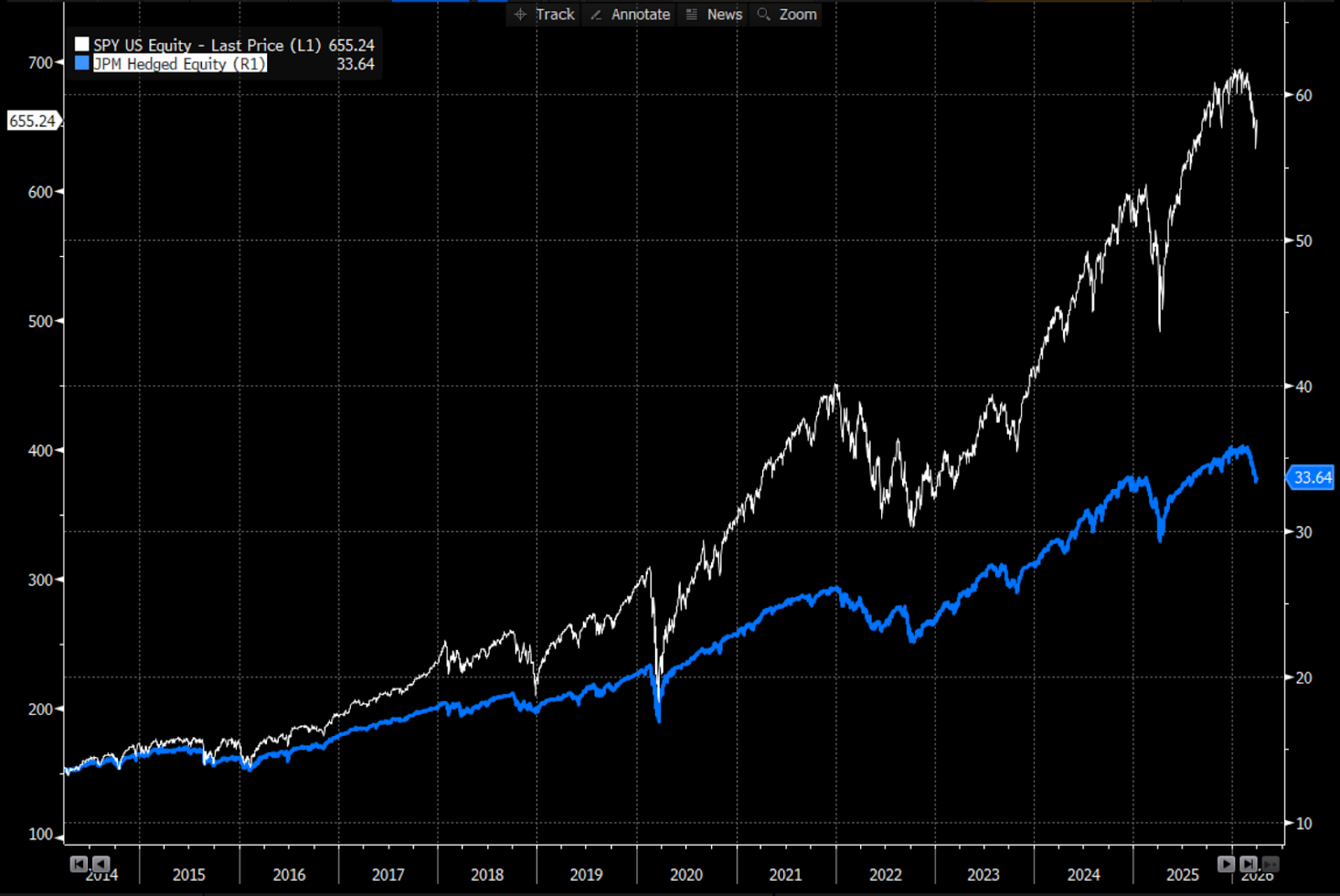
What bothers me most is that you ordered the “Curated Wellness Experience”. These funds do a big song and dance about how much this will protect your portfolio. Of the 6 major sell offs, this strategy was a good idea, exactly once. Every other time you got a smaller steak and a bigger bill.
Get the Ribeye
That “hedged” strategy gives you half the returns of the SPY on average, while tying up 100 percent of your money.
If you really want half the returns of the SPY. Just put half your money in the SPY.
Then take the other half, put it in T-Bills yielding 3.5 percent. That bumps the “hedged” strategy from 6 percent to almost 8 percent with a better risk profile.
That’s a 30 percent increase in return with better risk. $20B of institutional money is leaving that on the table. They are so busy with their complicated strategy, they forgot to do some simple math.
This isn't about this one fund. It's about how to read the menu.
Next time someone pitches you a strategy, do this. Ask what the downside is. Divide the upside by the downside. That’s your risk adjusted return. Compare it to other strategies. If that ratio is lower, you're ordering a “Curated Wellness Experience” at a steakhouse.
Get the ribeye.
Tim