

BY ANDREW GIOVINAZZI
July 7th, 2025
Hey there, Andrew here.
I’m looking at VIX sitting near 18 right now, and I think I’m losing my mind.
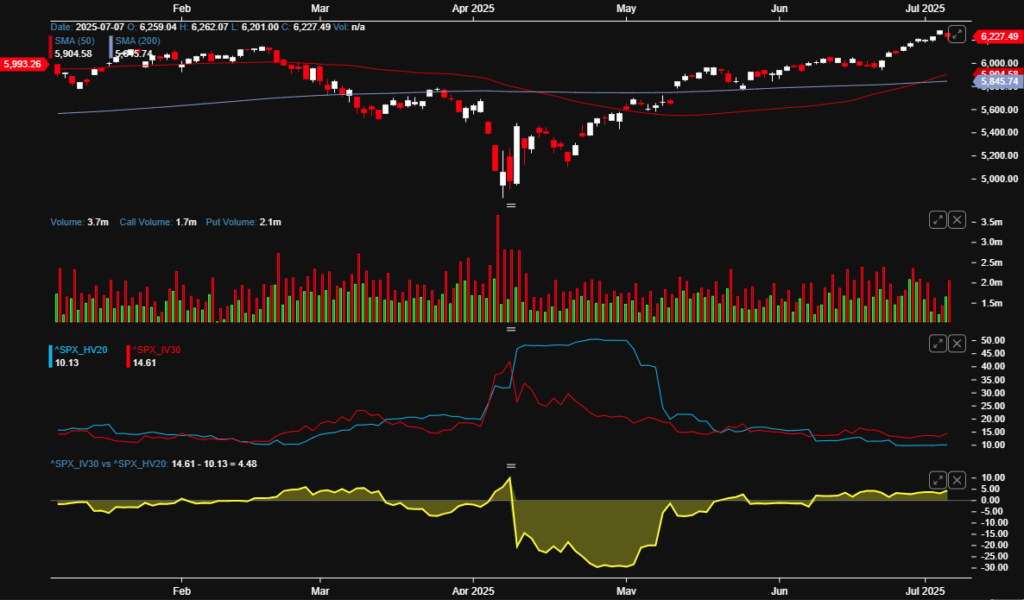
SPX just rallied 350 points or so since June 23rd. That’s not a typo. Three hundred and fifty points.
And VIX is still 18. For anyone keeping score at home, that’s the exact opposite of how this is supposed to work.
I think what’s happening here is we’re in one of those government-induced cycles where normal correlations just decide to take a vacation.
You know, the kind that makes you question everything you thought you knew about markets.
The Math That’s Keeping Me Up at Night
Here’s what I’m seeing that nobody’s talking about: at-the-money implied volatility keeps rising even as SPX climbs higher. That’s like gravity working backwards.
The VIX calculation is getting dragged up by options traders buying protection at levels that should be getting cheaper, not more expensive.
I think the market could price in a $300 straddle for next month. Right now it’s trading around $200.
That means traders are expecting either a drop back to 6,000 or a rocket to 6,500. And honestly? I can make a case for either scenario.
But here’s the thing – and this is where it gets interesting – those August 20 19 VIX puts at $1.43 and the August 20 18.5 puts at $1.20 are telling me something completely different.
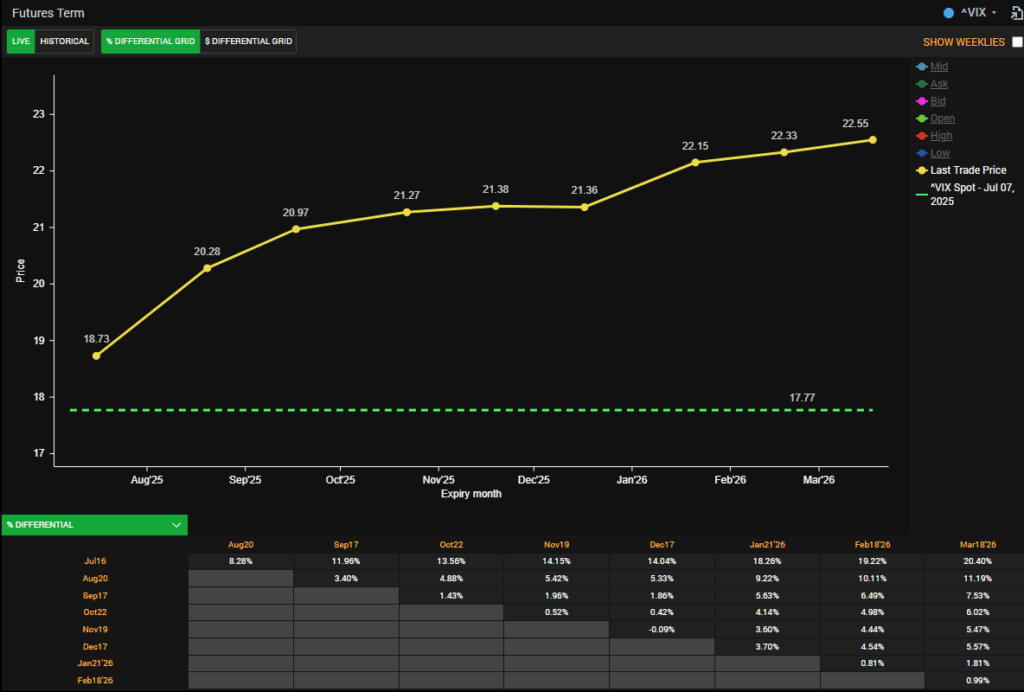
Those prices are basically saying volatility will never see the first quartile again. That we’ll never see normal conditions.
I think that’s wrong.
Why Experience Trumps Panic Every Time
Let me tell you about Stafford Trading. One of the most successful market-making firms in Chicago. Trading options for literally 50 years – since the CBOE was formed. Survived every crash, every crisis, every “this time is different” moment.
They blew out on a correlation trade in 2020.
Fifty years of experience. Gone. Because correlations that worked 80% of the time for decades suddenly didn’t work for a few months.
That’s why I do position sizing.
That’s why we trade once a week instead of going all-in on what looks like a “sure thing.” Because no matter how good a trade looks, the market can always work opposite of how it normally works.
The Tariff Smokescreen
Everyone’s focused on Trump and tariff policy. The trillion-dollar deficits, the borrowing costs, the uncertainty around trade numbers. And sure, that’s creating volatility. But I think that’s missing the real story.
The real story is that at-the-money volatility is being dragged higher by traders buying puts 1,200 points out of the money.
Fear buying at levels that make no mathematical sense if you believe in mean reversion.
I think this is artifact behavior.
Market makers expanding prices because they don’t know how to price uncertainty that big. So they’re just adding premium to everything and hoping it sticks.
What I’m Actually Doing About It
I’ve got positions on those August puts I mentioned.
Very, very inexpensive relative to what I think normal correlation should price them at. SPY went up 25 points and those puts are still hanging in there, which tells me the market knows something’s off too.
Right now, I’m not putting on new positions until things loosen up. When correlations break, you take a break too. But I think the edge on buying these puts is still very good because mathematically, do we really go up another 250 points with VIX staying at 18?
I think that’s harder than the market is pricing.
The Back-of-the-Envelope Reality Check
Here’s how we used to price things in the old days: Where was it? Where is it? Where can it go?
We just traded 6270 last week. If we trade back down to 6000, you think the market’s going to price that straddle for less than $300? When we were just at those levels a week ago?
That’s roughly VIX at 27-28. Nine points from here.
I think that kind of rough-and-tumble analysis still works better than whatever algorithm is pricing these correlations right now.
The Action: The August 20 19 VIX puts at $1.43 and the August 20 18.5 puts at $1.20 are pricing in a world where volatility never normalizes.
I think that’s wrong.
When the tariff noise settles and correlations remember how to work normally again, these should pay off. Just don’t bet the farm – position sizing is everything when you’re trading against “opposite of how it normally works.”
Because VIX is still 18 for a reason. Traders are expecting something to move. I think they’re right about the move, just wrong about the direction.
Andrew “Will Things Ever Be Normal” Giovinazzi
P.S. I think Mark’s onto something with this cash zone strategy he’s been trading. He’s averaging around 20% daily returns on just one stock, which honestly sounds too good to be true until you see the math. I keep telling people – when correlations break like this, you need strategies that work in single names instead of trying to trade the whole market. Mark’s approach might be exactly what we need right now.