

BY MARK SEBASTIAN
November 29, 2024

Let’s take a snapshot of our two competitors….
AMZN:
Revenue 620 Billion
TTM Income 49.9 billion
EPS: 43.17
Market cap…2.07 trillion.
Debt to equity Ratio: .21
Total Long Term Debt…54.89 billion….
WMT:
Revenue: 665 billion
TTM: 15.55 billion
EPS: 46.56
Market Cap 727 billion
Debt to equity ratio: .46
Long Term Debt: 41.5 billion
The numbers are a mixed bag for both teams…on one side Amazon makes more money and has a much higher market cap…on Walmart’s side…the company has a much higher Debt to equity ratio and has less debt.
Looking at the business models…WMT and AMZN are essentially the same company except for one major difference…AWS…which happens to be the most profitable portion of the company’s business.
On the other side…WMT doesnt have AWS..but what they do have is real estate…and a lot of it.
We should kind of ignore the valuation portion…because AWS is probably worth over a trillion dollars…but the retail side…
Amazon’s advantage is logistics…they have this down…the speed with which they can get a package from order to door is astounding.
What they do not have though is retail space…same day pick up..and stores that can also be procurement centers.
Walmart’s advantage is convenience…hey I need a hammer…I’ll drive down to Walmart and buy a hammer right now…same day pick up…and the fact they can use stores as distribution centers.
Online as a member of both Prime and Plus…the experience is essentially the same….
With both of these companies having pretty darn good financials and my belief that they will be around for the long haul..it comes down to this…PE.
For the 1st time…maybe EVER AMZN has a lower PE than WMT…that makes me want to buy AMZN over WMT…
But the charts might be different…Licia?

I think we can all say how easy it is to use Amazon (Ticker: AMZN) to buy so many things.
I actually used to try and use the small book outlets and they were terrible.
I also shop at Walmart (Ticker: WMT) while I am in Arkansas, it is a great store and they carry everything, too.
So let’s take a look at the charts.
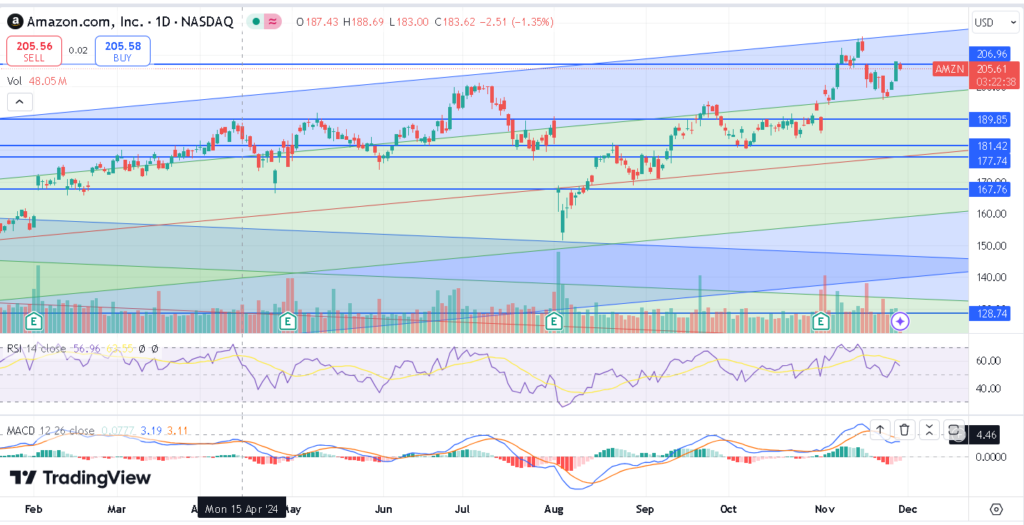
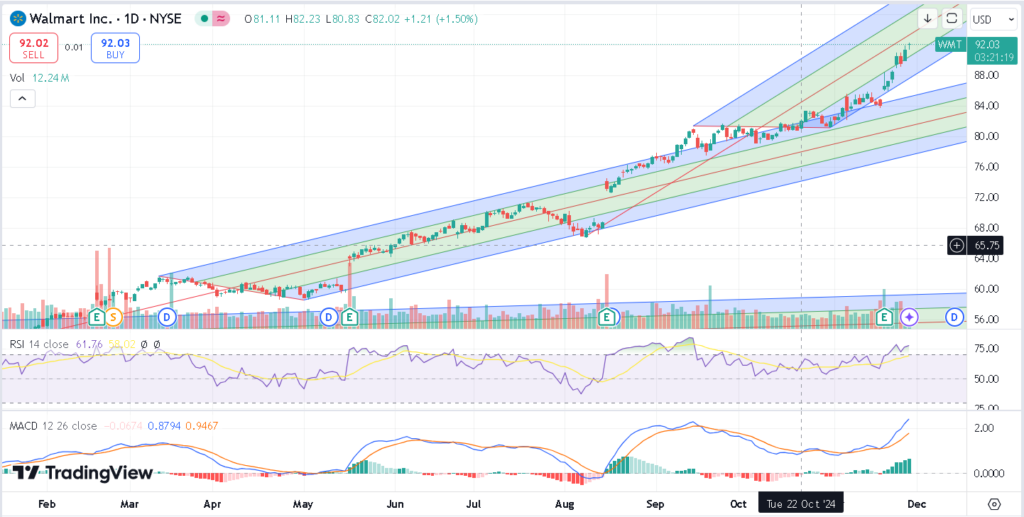
At first glance AMZN is moving sideways while WMT is having a really nice rally.
AMZN is actually slowly marching higher.
It looks primed to make another run to its most recent high at $216.
Once it clears that level, I think it can trade $230.
On the downside AMZN has support at $197 and then $189.85.
WMT has the more bullish looking chart with a steep pitchfork taking it to $97.
Once it trades $97, $100 is in order.
On the downside, WMT has support at $89.30 and then $87.44.
Let’s see what Vol Man has to say about the implied volatilities for these stocks.

AMZN and WMT Vol. Is it the battle of the titans?
As big as the behemoth revenues of both companies IV is pretty low for both. AMZN coming into the holiday season is near year lows as is WMT. The difference is WMT just goes up as a store of value and AMZN has charted a more volatile path. $200 is a tough area for AMZN and WMT has no top since the stock split.
What that means is WMT has relatively low realized volatility and AMZN a little higher realized volatility.
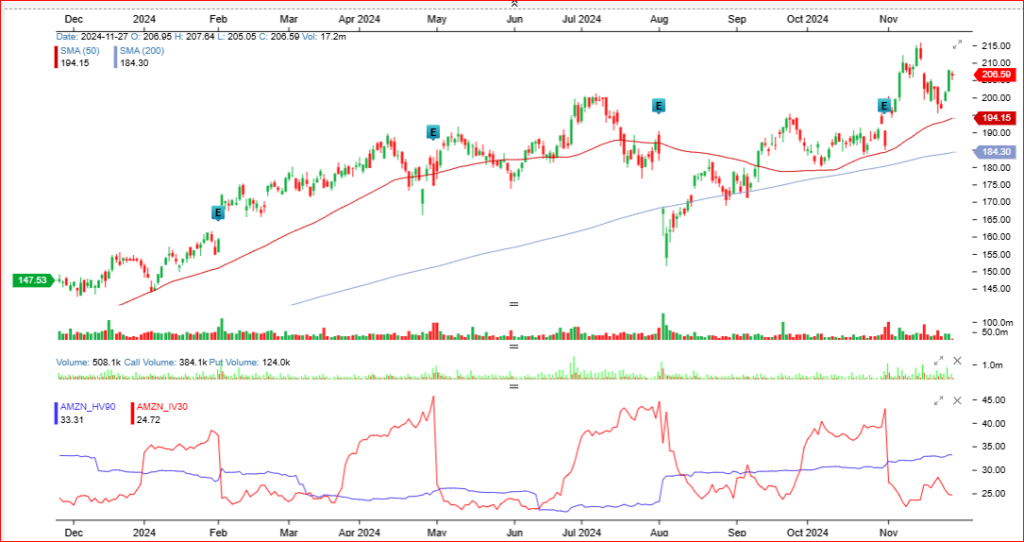
AMZN 90 day realized volatility with 30 day implied volatility
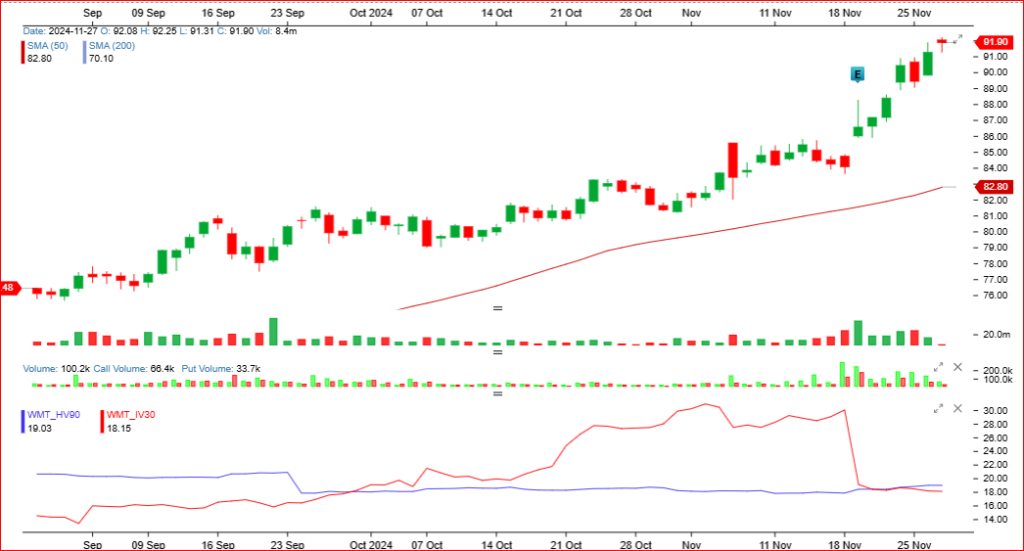
WMT 90 Day realized with 30 day implied volatility
From a volatility perspective, buying longer term options would suit both however the relative lower premiums in WMT means puts closer to the money would work better.
I like long time and long volatility in both here and leaning long deltas right now.

Walmart is a bit like Costco in that it does what it does very well. It doesn’t try to veer away from its core business. Quite simply, there are few companies better at providing everyday goods to real people both in store and online. It has solved the grocery shopping/pick up puzzle and people are loving it. Order your steaks and have them ready for pick up after work? No problem. Importantly, it has also managed to completely mow Target’s lawn, which used to capture more of the discretionary part of everyday retail. Walmart has gotten much better at this side of its offering and in doing so has increasingly captured upper middle class consumer spending. Target sad.
Amazon, however, is one of my favorite companies, an interesting mix of new world and old – a digital mastermind in cloud, but also a company that has managed its very large physical goods delivery business to perfection. It has redefined goods logistics for the next 100 years and few competitors are able to keep up. Even in a boring business like warehousing, they have managed to leave the competition years behind with its use of cutting edge robotics and automation. Efficiency. Productivity. Next-level stuff.
One other thing tips me towards Amazon.I think Walmart has gotten a little ahead of itself on the chart – it has gone fairly parabolic and valuation reflects it. Walmart trades at a 34.49 forward PE, while Amazon sports a 35.6. They are neck and neck, but I think Amazon is better poised to grow its online e-commerce share of ALL goods. It has better potential to be the go-to easy button for more consumers across all product ranges around the world. Domination.
Now what about income trading… Well, from an option pricing perspective I’m not jumping up and down over what I’m seeing but WMT call premiums are not too bad at the 95 strike in January. Someone who has been fortunate to own this stock could do well to sell the January 95 calls against their holdings to capture about a 1.7% yield for around 51 days work, plus a yield to strike return of 3.5%. In total that represents a 5.2% call-away gain for their Walmart position. Amazon…. Well I would just stay long the stock until around 225, where I would then consider some call sales.

Mark – this is a clash of Titans.
With big companies comes equally big regulatory pressures.
Or maybe it’s “with big corporate power comes big regulatory responsibilities.”
I’m not sure, but you get the point.
Regardless, the regulatory environments for Walmart (Ticker: WMT) and Amazon (Ticker: AMZN) have evolved distinctly, influenced by their business models and market positions.
Going forward, both will be subject to competing pressures.
What Keeps the Waltons Up at Night?
In addition to theft, WMT’s $6.5 billion in losses due to retail theft accounted for 14.7% of all retail theft in the United States, WMT is grappling with:
- Diversity, Equity, and Inclusion (DEI) Policies: WMT has recently scaled back its DEI initiatives, discontinuing programs that prioritized suppliers based on gender or race. This shift aligns with broader corporate trends reassessing DEI commitments amid legal challenges and political pressures.
- Tariff Implications: WMT has expressed concerns over proposed tariffs on imports from countries like Mexico, Canada, and China, indicating that such measures could lead to higher consumer prices.
What Keeps Bezos Up on his Yacht?
Reports have surfaced accusing AMZN of allowing manipulated customer reviews, particularly involving China-based company Vevor, which is alleged to have created multiple listings for identical products to avoid negative feedback, a practice that violates AMZN’s policies and U.S. consumer protection regulations.
- Antitrust Scrutiny: In September 2023, the Federal Trade Commission (“FTC”), along with 17 states, filed a lawsuit against AMZN, alleging that the company maintains monopoly power through exclusionary practices, which has led to higher prices and stifled competition.
- Labor Relations: AMZN (alongside SpaceX), recently argued before the U.S. Court of Appeals for the Fifth Circuit that the National Labor Relations Board’s (NLRB) structure and proceedings are unconstitutional. This legal action follows complaints accusing AMZN of improper interference during union elections and unlawful employee terminations. It is unlikely that AMZN and SpaceX will succeed, but if they do, it will weaken the NLRB’s authority. Whatever the decision by the 5th Circuit, it will most likely end up at the Supreme Court.
Conclusion
Going forward, for WMT it will be a balance between the Trump administration’s proposed tariffs on imports, which could impact WMT’s supply chain and potentially increase costs and pricing strategies, and a deregulatory environment that may reduce compliance burdens.
For AMZN, it will be a similar balance of tariff disruption on pricing and supply chains, especially concerning goods imported from China, versus the likely adoption of less aggressive policies on antitrust enforcement under Trump.
Want To Watch Us Live?
Add Our Free Events To Your Calendar By Clicking Your Email Icon Below!


