

BY MARK SEBASTIAN
March 21, 2024

Each week, my team will give an overview of a stock. I’ll discuss fundamentals, Licia will analyze the charts, and AG will break down the volatility.
Have a stock YOU want us to review? Email my team here. – Mark
General Electric (Ticker: GE)
&
NuScale Power Corporation (Ticker: SMR)

According to the Ivory Tower, COP28 Climate Summit, Davos crowd, who flew in on their private plans, the world is supposed to be emission free by 2050.
That means weaning ourselves completely off fossil fuels.
With no fossil fuel, what’s left – wind … solar … nuclear.
Well, to get the world to zero emissions by 2050, the world would need to build, commission, and bring on-line either:
- One 2.1 gigawatt (GW, 109 watts) nuclear power plant each and every day until 2050, OR
- 3,000 two-megawatt (MW, 106 watts) wind turbines each and every day until 2050 plus a 2.1 GW nuclear power plant every day and a half until 2050, assuming there’s not one turbine failure for any reason, OR
- 96 square miles (250 square kilometres) of solar panels each and every day until 2050 plus a 2.1 GW nuclear power plant every day and a half until 2050, assuming not one of the panels fails or is destroyed by hail or wind.
That’s a daunting task.
And it certainly looks like nuclear power is the best option for reaching unattainable goals.
Currently the U.S. gets about 25% of its electricity from nuclear power.
To meet Biden’s 2035 climate goals that number needs to be at least 50%.
Perhaps that is why the U.S. and 17 other countries pledged at last year’s climate summit to triple nuclear power by 2050.
That will require new power plants.
Many of the current nuclear reactors are nearing the end of their lifespans … typically 40 years.
In fact, almost two-thirds of the world’s operating reactors will be running on empty by 2030.
But what to build?
There are two core approaches to nuclear power generation: Small Modular Reactors (SMRs) and large-scale reactors.
Each has its unique advantages and challenges, with SMRs generating about one-third the energy of a conventional nuclear reactor.
We don’t have to choose one source over the other.
They can be used in tandem since the decision between deploying SMRs versus large-scale reactors often comes down to the specific needs and constraints of the area they are intended to serve, as well as other factors:
Cost
- SMRs: have a lower initial capital investment due to smaller size and the ability to fabricate components in factories and ship them to the site, but have a higher cost per unit of electricity generated (kWh) compared to large reactors due to less economies of scale in operation.
- Large-Scale Reactors: have a lower cost per kWh because they can produce more power more efficiently once they are up and running, but they have high initial capital costs and financial risk, which can be a barrier for utilities.
Reach to Rural Communities
- SMRs: more adaptable for remote or rural areas due to smaller size and power output, which matches the lower demand, but they are limited by the need for infrastructure such as cooling water and electrical grid connections, which can be challenging in remote locations.
- Large-Scale Reactors: can serve as a backbone for a large, stable power grid, providing consistent energy to both urban and rural areas if grid infrastructure is developed, but they are less feasible for remote areas due to larger output and infrastructure requirements.
Time to Build
- SMRs: have shorter construction times due to modular components being built in a factory setting and then assembled on-site, reducing project complexity and construction risk, but the relatively new technology may be subject to stricter regulatory delays.
- Large-Scale Reactors: provide well-established technology with a track record of construction and operation, providing a clearer timeline for completion, albeit longer, but construction of large reactors can take a decade or more due to their complexity, regulatory hurdles, and often significant public opposition.
Safety and Waste
- SMRs: designed with advanced safety features that could lower the risk of accidents and generate less waste due to smaller size and innovative designs, but greater numbers could increase the risk of operational mishaps or security concerns.
- Large-Scale Reactors: decades of operational experience have led to a deep understanding of safety measures, risks, and waste management practices, but they produce large volumes of nuclear waste requiring long-term storage solutions.
Environmental Impact
- SMRs: have a smaller footprint and potentially less environmental disruption during construction and operation, with proximity to end user minimizing transmission losses, but the environmental impact per unit of energy produced could be higher than large-scale reactors due to less efficiency in materials and fuel use.
- Large-Scale Reactors: highly efficient in terms of fuel use and energy production, minimizing the environmental impact per kWh of electricity generated, but have a large footprint and significant environmental disruption during construction.
All in all, the country can’t adopt a sufficient amount of nuclear generation without adopting SMRs. That is particularly true if nuclear power is to reach more remote, rural communities.
SMRs are smaller in size, more flexible, and more cost-effective than larger reactors.
SMRs typically generate between 10 and 300 megawatts (MW) of electricity, compared to the 1,000 MW or more produced by conventional reactors.
Their modular design allows for scalability, with the option to add or remove reactor units based on demand, which provides advantages for rural electrification:
- Lower Costs: Due to their smaller size and modular construction, SMRs have lower capital and operational costs. This makes them feasible for rural areas with limited budgets.
- Scalability: SMRs can be scaled up or down based on local energy needs, accommodating population fluctuations or changing requirements.
- Minimal Environmental Impact: SMRs produce minimal greenhouse gas emissions, contributing to a cleaner environment. Their compact size also reduces land disruption during construction.
- Reliability: Unlike solar and wind power, SMRs provide consistent, around-the-clock energy, ensuring steady electricity supply.
- Energy Security: SMRs can operate independently of national power grids, offering a reliable source of power during grid failures or natural disasters.
The Nuclear Regulatory Commission (NRC) recently certified a design for an SMR, a 12 reactor, 50MWe design, developed by NuScale Power Corp. (Ticker: SMR).
NuScale’s SMR is half the size of a typical reactor and can be modularly constructed.
What NuScale and other SMR producers need is a pipeline of orders.
That is why the U.S. government is working with SMR developers and the government-run Export-Import Bank and the U.S. International Development Finance Corp. to win overseas orders that will bring down costs and build an order book.
The group has arranged up to $4 billion in financing for a NuScale plant in Romania.
In November, the U.S. signed an agreement to facilitate the sale of nuclear-energy technology and material to the Philippines.
Talks are also ongoing with Polish energy company Orlen, which wants to build SMRs designed by GE Hitachi Nuclear Energy.
U.S. officials also claim that discussions are advancing with Bulgaria, Ghana, Indonesia, and Kazakhstan.
NuScale Power Corp (Ticker: SMR) and General Electric (Ticker: GE) through its joint venture with Hitachi (GE Hitachi Nuclear Energy) are both moving to develop and deploy SMRs.
NuScale Power Corp
The company focuses on light water reactor technology with its NuScale SMRs, designed to be safer and more economical than traditional nuclear reactors.
NuScale deploys small, modular units, which allows for reactors to be produced in a factory setting and transported to their installation site.
Each NuScale reactor has a power output capacity of 77 MWe, and the design allows for modules to be combined to meet specific power needs.
NuScale emphasizes safety and efficiency, with reactors that can be cooled passively in the absence of power and operator intervention.
General Electric
GE, through its partnership with Hitachi, GE Hitachi Nuclear Energy, offers the BWRX-300, a small modular reactor that employs a simplified design to reduce construction costs and time.
The BWRX-300 is a boiling water reactor with an electrical output capacity of 300 MWe.
GE targets a wide range of applications beyond electricity generation, including hydrogen production, desalination, and district heating.
GE Hitachi highlights the BWRX-300’s cost competitiveness and reduced environmental footprint compared to traditional reactors.
GE Hitachi recently won an SMR installation project in Estonia through Fermi Energia.
It beat out NuScale and Rolls-Royce (Ticker: RYCEY).
Outlook for the Next 6 Months, 1 Year, and 3 Years:
- Short-term (6 Months): Both companies are likely to focus on advancing regulatory approvals, securing partnerships, and beginning or continuing construction on pilot projects.
The immediate success will largely depend on regulatory outcomes and the ability to maintain projected cost and timelines.
NuScale’s recent project cancellations in the Western U.S. highlight the challenges faced in securing enough subscription and funding, despite technological advancements.
- Medium-term (1 Year): Continued progress in construction and demonstration projects for both companies will be key.
NuScale may need to overcome recent setbacks and focus on smaller scale projects or diversify into other markets.
GE Hitachi could see increased interest in the BWRX-300 as it advances in regulatory processes and begins construction on projects in North America and abroad.
- Long-term (3 Years): The broader adoption of SMR technology will depend on successful demonstration of the operational and economic benefits of the first few plants.
NuScale’s focus on safety and modular scalability could make it a strong competitor in markets looking for flexible power solutions.
GE Hitachi’s BWRX-300, with its cost-effective design and broader application potential, could see adoption in a variety of new markets, including those looking to transition from fossil fuels to nuclear power.
Both companies’ futures in the SMR market will be influenced by factors such as global energy policies, technological advancements, market demand for clean energy, and economic considerations surrounding the construction and operation of nuclear power plants.
But GEH has already won contracts and has a memorandum of understanding or other agreement in place with companies in Canada, Czech Republic, Poland, the UK, the USA, UK and Sweden.
NuScale has yet to actually deploy a reactor.
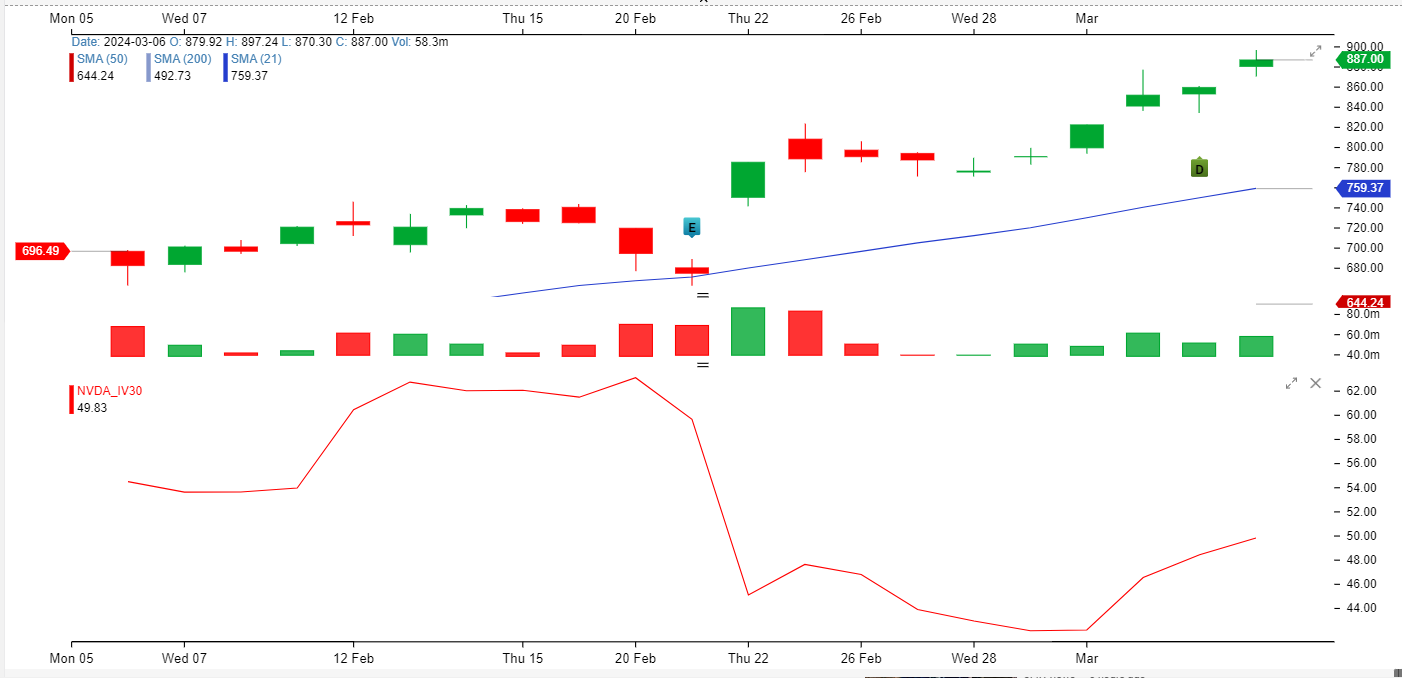
The rally in option prices (the red line) as the stock is hitting new highs tells me traders are getting really nervous…
I think there is a 2-4 day sell off coming in NVDA.
At 2 Trillion…I think the company is fully valued and I would…as stated above be looking to buy competitors.

General Electric (Ticker: GE) has had quite the rally since bottoming out back in October 2022 at $48.00
You have to go way back on the chart to find the last time it traded this high at $170.
It was back in June 2017.
GE topped out with a shooting star candle on March 8th and has since had a small pullback.
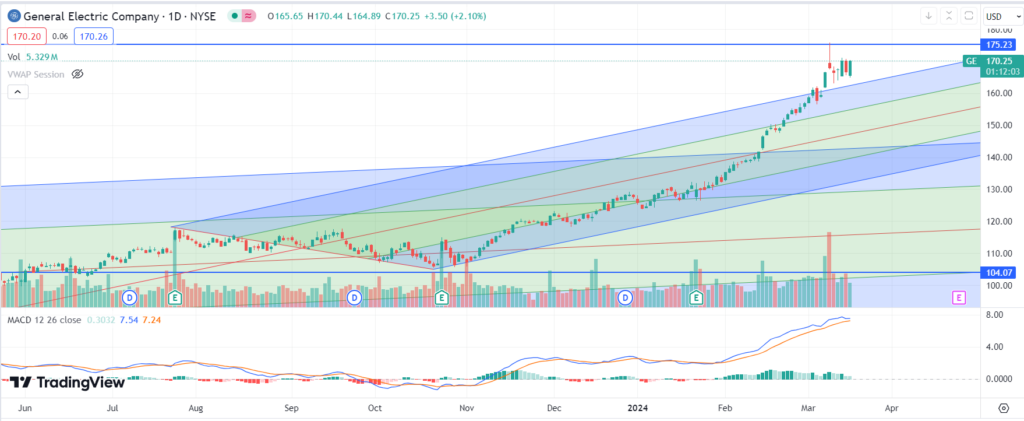
The stock is currently consolidating here with some wide range large bullish and bearish candles.
It is trying to decide if it is going to rip backup and beyond $175 to $192.
Support comes in at $162.70 and then $157.
NuScale Power Corporation (Ticker: SMR) has a very bullish chart.
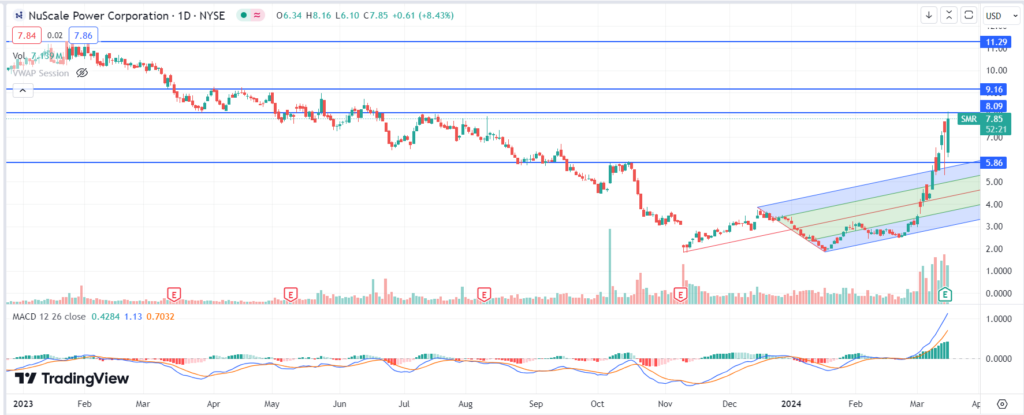
This stock is going to $9.16 and then $11.30.
The all time high, made in August 2022, is just shy of $16.
I think this stock will trade there again.
Support comes in at $6.87 and $5.83.
-Licia

My Vol take on GE
If you listen to Frank, which I do, GE is starting to sell the small scale nuclear reactors with Hitachi. Bigger growth leads to animal spirits and that leads to call buying. Note below that traders are pushing up volatility in the 60 to 90 day time frame in GE. They are buying calls even as the stock volatility, purple line in the chart, dives.
When stocks go one way, realized volatility in the underlying sags. Implied volatility is not cheap in GE so I would employ a spread to save some volatility risk.

60 and 90 day IV with 90 historical volatility for GE
The bigger volatility price was a surprise so at least for now Frank is not the only one, Mark too, that likes GE’s prospects going forward.
The Option Pit Team…
P.S. To see the live show every Monday at 10:30 just sign up for any paid service here at Option Pit... or call 888) 872 3301.
Questions about anything? Leave a comment below!

Mark Sebastian
Founder & CEO, Option Pit

See what's hot at option pit
CAPITOL GAINS: SMR Aug16 7 call closed for a 150% gain
DELTA STRIKE: VLY Mar15 8 puts closed for a 88% gain
PFE May17 26 calls closed for a 66% win
OP MENTORING: SPY Mar22/19 510 put calendars and 520 calls for 6.4% gain
OPTION SHOPPER: ERX Mar28 65 calls closed for a 90% gain