
Dear Income traders,
I've got two names on the screen this week pulling in opposite directions.
One grew earnings 116 percent last quarter and got sold anyway. The other is the most popular product in crypto, running on a business model that hasn't changed since 2009. I want to own the first and stay well clear of the second.
One to Love: They Beat, and Got Sold Anyway
Sterling Infrastructure (STRL) builds the ground under data centers. Site work, power, the dirt and electrical that go in long before anyone racks a server.
Last quarter it turned that into $5.80 in adjusted earnings per share (profit per share, stripped of one-time items), up 116 percent from $2.69 a year ago. Revenue hit $1.17 billion, up 90 percent. Signed backlog, meaning work already under contract, reached $4.3 billion.
Management then raised full-year adjusted guidance to $19.70 to $20.30. Sterling earned $10.88 for all of last year.
Then the stock fell 15 percent.
The bear case is real, so let's deal with it. GAAP earnings guidance came in at $17.25 to $17.85 against the $18.81 the Street wanted, free cash flow margin slipped to 9.6 percent from 11.7, and Transportation revenue dropped 20 percent.
That last one isn't damage. Sterling pulled crews off low-margin highway work and put them on data centers, where revenue grew 192 percent at 24 percent margins. The market read a mix shift as a miss.
Now look at the price. Around $576, STRL trades more than 40 percent below its June high of $1,005.68, even as the full-year earnings number went up. That's roughly 29 times this year's adjusted guidance, against the 47.6 trailing multiple it carried into the print.
The analysts who got spooked cut their targets and still couldn't get them under the stock. Cantor Fitzgerald went from $956 to $742 and kept its Overweight. KeyBanc went from $922 to $754 and kept its Buy.
I'll take the disconnect between a business compounding at this rate and a crowd that lost its nerve over a mix question. I like it here.
One to Leave: Scarcity Isn't a Business Model
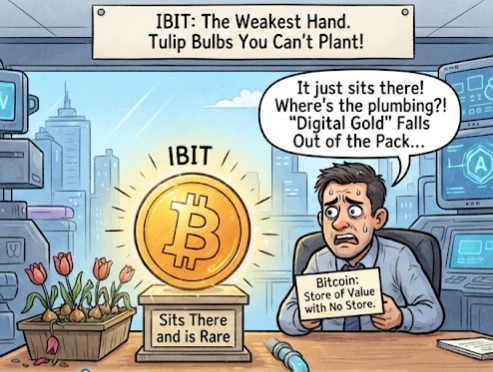
The iShares Bitcoin Trust (IBIT) is a clean, cheap way to own bitcoin. My problem isn't the wrapper. It's what sits inside it.
Bitcoin's entire pitch is that only 21 million will ever exist. Scarcity is the whole product, and scarcity only pays when the next buyer shows up willing to pay more than you did.
This year, fewer of them showed up. Bitcoin fell 33 percent in the first half, slipped under $60,000 by the end of June, and sits near $63,000 now.
The flows say the same thing. U.S. spot bitcoin funds shed $5.4 billion in the first half, their first negative half-year since launch. Net flows have run negative in 54 percent of trading sessions this year, versus 31 percent back in 2024.
Give the bulls their due. IBIT pulled in $693 million in the week ended August 7, its best stretch since April. That still leaves a $4.5 billion hole for the year.
Meanwhile, the money doing real work has gone elsewhere. Tokenized real-world assets, meaning Treasuries and credit and funds issued directly on a blockchain, grew from about $11.8 billion to $32 billion in twelve months. Ethereum holds roughly 65 percent of that value.
Chainlink runs better than 62 percent of the oracle market, according to VanEck. An oracle is the feed that tells a smart contract what a bond is actually worth, and that piece has to work before any of this touches a real balance sheet.
In December, the DTCC, which safeguards north of $100 trillion in securities, got SEC clearance for a three-year pilot to tokenize the assets it custodies. Rollout starts this half.
Every one of those tokens has a job to do inside a transaction. Bitcoin's only job is to sit there and be scarce. I'd rather own the plumbing than the collectible.
Sterling and IBIT are exactly the kind of split the crew argues over on Monday. Five of us bring two names each, and Mark works the list live.
So which one will the crew pick for Monday's Ticker Highlight Show? Tap here to join at whatever rate you want and get Monday's pick as soon as it hits.
Here for a good time AND a long time,
Hans