

Dear Income traders,
The market is acting calm on the surface.
Underneath? Not even close.
The S&P 500 is sitting just shy of all-time highs, up near 7,500. The Nasdaq is being dragged higher by a handful of semiconductor names. And the VIX (the market's "fear gauge," which measures how much movement traders expect over the next month) has compressed back to the mid-teens after spiking toward 22 around the Fed's June meeting, the first under new Chair Kevin Warsh.
If you only look at the index level, you could convince yourself this is a normal bull market.
That would be a mistake.
Because the real story isn't the index.
The real story is dispersion.
For the past year, I've been calling this the Ultimate Age of Disruption: a market where AI, rates, geopolitics, and capital concentration mint extreme winners and extreme losers at the same time.
Now the data has caught up.
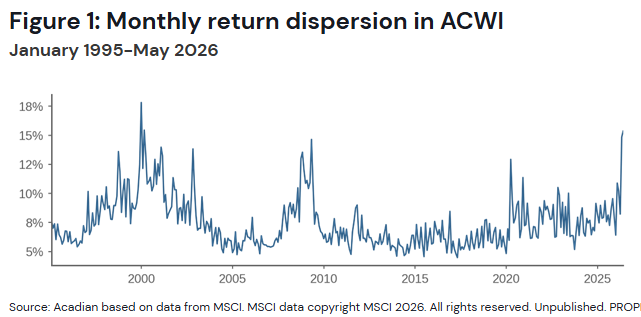 Source: Acadian based on data from MSCI.
This chart shows monthly return dispersion in the MSCI All Country World Index (basically every major stock on earth in one basket) going back to 1995.
Translation: how wide the gap is between the winners and the losers across global stocks.
And we're now back near levels last seen during the tech-stock bubble.
Here's the thing: that's not a feeling. It's a measurement. Dispersion ran 15.0% in April and 15.6% in May. The average since 1995 is 7.6%. Those two months rank third and fourth highest in 31 years of data, behind only December 1999 and February 2000, the exact top of the dot-com mania.
Why does that matter?
Because high dispersion isn't just "volatility." It's the market telling you capital is violently reallocating. Money isn't lifting everything equally. It's crowding into the perceived AI winners, abandoning weaker business models, punishing shaky balance sheets, and forcing investors to decide what they actually own.
This is exactly what disruption looks like in real time.
Look at May. Micron jumped 87.8% in a single month. SK Hynix rose 78.6%. Both started the month under 1% of the global index (its "weight," or how much of the basket it represents), yet together those two names drove 17% of the entire index's monthly return.
Let me tell you how strange that is. In a database of more than 800,000 stock-months going back to 1995, those are the first- and fourth-largest contributions ever made by a stock weighing less than 1%.
That is not normal market behavior. Small companies can move 50%, 75%, even 100% in a month. Whole index ecosystems should not be meaningfully reshaped by a handful of mega-cap moonshots.
And here's who's saying it. This isn't me waving my arms.
It's Owen Lamont, a portfolio manager at Acadian and a former finance professor at Chicago, Harvard, Yale, and Princeton. He writes a research blog called Owenomics, and for the past two years he's been the calm voice in the room. Back in February, with the S&P breaking 7,000 for the first time, he was one of the few willing to say flatly that there was no bubble.
This month he changed his tune.
In a post titled "The Whirlwind Is Upon Us," he walked through the dispersion data above and called it what it is: the global market is now as turbulent as it was at the height of the dot-com boom. His phrase for where we sit today: "the season of chaos is at hand."
Let me tell you why that lands harder coming from him. Lamont isn't a permabear hunting for a crash under every rock. He spent the last two years arguing the AI spending boom was a rational bet rather than mania, more like railroads laying track than tulips changing hands. So when the guy who kept telling everyone to relax suddenly writes that the chamber of dispersion has opened, you stop scrolling and read it twice.
Now, the honest part: high dispersion doesn't tell you which way this breaks. Lamont lays out both roads. If this is 1999-style speculation, it reverses, hard, the way it did when the market peaked in 2000 and bled through 2001. If it's a 2020-style repricing around a real shift, like AI genuinely rewiring the economy, the winners keep winning and the moves don't reverse.
Nobody knows yet. But you don't have to know the ending to prepare for the volatility.
Because that's what dispersion guarantees: in a market splitting this violently between winners and losers, owning the index just means owning the fight. The action, and the risk, lives in the individual names.
Lamont calls it the season of chaos. I call it the Ultimate Age of Disruption. Same beast, different name. Either way, it's here, and it rewards the traders who pick over the ones who hide in the index.
Check out Turbo Income for how we trade these sorts of names.
Here for a good time AND a long time,
Hans