

Hey Traders,
We bounced in the morning.
And then the floor fell out.
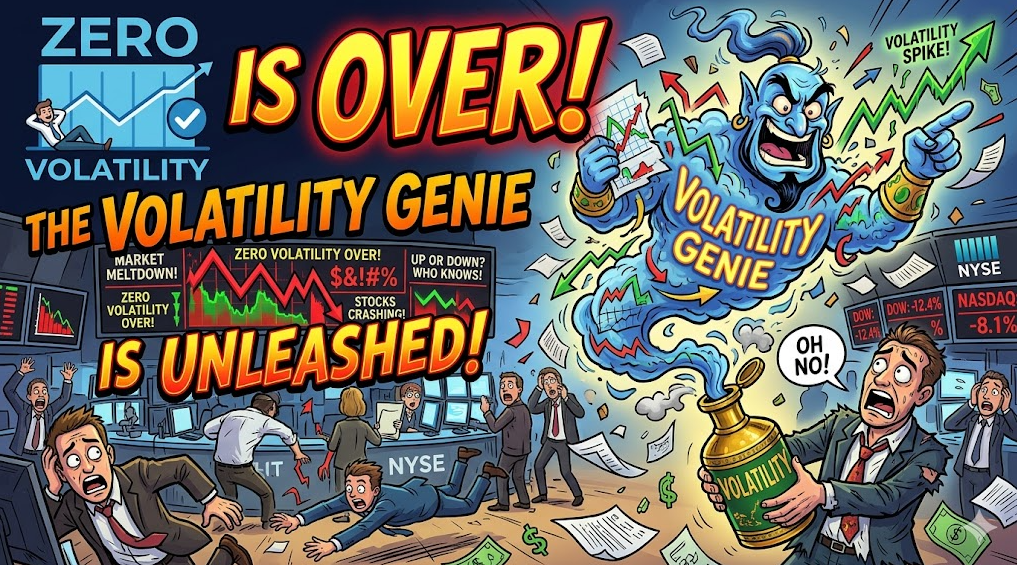
That is what happens when the volatility genie gets unleashed.
For the last couple of months, we have had a market that only wanted to do one thing: go up. Up, up, up.
Every dip got bought. Every squeeze got chased. Every story stock became a rocket ship.
You could see it everywhere.
Individual stocks were running 30 percent, 40 percent, even 50 percent in a few days. In some cases, almost overnight.
And this was not just tiny spec stocks. We saw signs of FOMO in major companies too. International Business Machines (IBM), of all things, had upside call skew (traders suddenly paying up for bets that the stock keeps climbing) absolutely explode.
I have been talking about that because it matters.
When investors stop buying protection and start paying almost anything for upside calls, that tells you something.
It tells you the crowd is not positioned for balance.
It tells you the market is no longer calmly discounting earnings, AI, productivity, or anything else. It is chasing.
Upside call volume was everywhere. The put-call ratio (a quick read on how many downside bets traders hold versus upside bets) was wildly lopsided.
Nobody wanted insurance. Everyone wanted lottery tickets.
That does not mean the market has to crash.
But it does mean the rally is living on borrowed time.
And when a rally like that finally breaks, it often does not break gently. It breaks by shifting from one-way volatility to two-way volatility.
That is exactly where we are now.
For weeks, volatility worked in one direction. Stocks squeezed higher. Shorts got steamrolled.
Anyone underweight tech or AI felt forced to chase.
Now the market is being reminded that volatility can also mean down.
You did not have to wait long to see it. The iShares Semiconductor ETF (SMH) fell about 10 percent on Friday, its worst single day in six years. Micron Technology (MU) lost roughly 20 percent in two days.
And honestly, that is not necessarily unhealthy.
We do not want two percent or three percent daily moves forever. That gets exhausting fast.
But we also do not want a market that climbs in a straight line. The longer that runs, the more dangerous the eventual reversal becomes.
A little two-way action can actually make the market healthier. It resets expectations. It shakes out some of the easy FOMO.
It reminds people that risk management still matters. And it gives income traders (the folks who sell options to collect steady premium, like a landlord collecting rent) something to work with again.
This week also has a lot going on.
We get the May Consumer Price Index tomorrow. That matters because the market has been leaning hard into the idea that the Fed eventually gets more comfortable.
A hotter inflation print would challenge that. A softer one would probably calm nerves.
Then we have the SpaceX (SPCX) IPO on Friday, and this is not a normal IPO.
It is expected to be massive. Record-breaking massive.
Here are the actual numbers. The deal prices SpaceX at $135 a share, which works out to roughly $1.77 trillion. That would make it the seventh largest company in the country, bigger than Tesla, and the largest IPO on record.
With an offering that large, there is more going on than excitement around a famous company. There is positioning. There is fund-raising.
There is selling of other winners to make room. There are institutions trying to figure out where space (haha) can be made, what needs to be trimmed, and how much money has to move around to get a slice everywhere this new stock needs to be.
That creates noise. It creates movement. It creates volatility on top of already frothy moves in semiconductors.
It also creates a very real valuation debate. What is SpaceX worth? What price makes sense?
Consider the spread. SpaceX did about $18.7 billion in revenue last year, up 33 percent, but it still lost close to $4.9 billion. The IPO asks for $1.77 trillion while Morningstar pegs fair value near $780 billion, less than half the sticker.
So how much future growth is already being paid for? How much of the story is space, Starlink, AI infrastructure, Elon premium, or just pure market excitement?
Those are not small questions.
So now we have gone from a market that was mostly short squeeze (when bearish traders are forced to buy back and push the stock higher) plus FOMO to something more balanced.
Maybe more volatile.
Maybe less fun.
But probably healthier.
My view is that we continue to see big intraday swings for a few days. The market got too comfortable, and now it has to relearn two-way price action.
But I also think some calm can return once the SpaceX IPO is behind us, assuming the world does not end, which it probably will not.
Then we get back to the real backdrop. Earnings are still strong. The AI buildout is still real.
The productivity story is still developing. And I still think we are moving toward a rotation inside the AI trade.
The builders have already been rewarded handsomely. The market has paid up for the infrastructure names, the chips, the power names, the data center names, and the obvious AI plumbing.
Now I think the next phase may be about the users and beneficiaries of cheap AI.
Companies that can use AI to improve margins. Companies that can turn AI into better products. Companies that benefit from more software, more automation, more data, more business formation, and more digital activity.
That does not mean the builders are done. It means the market may start asking a better question.
Not just: "Who builds the AI world?"
But also: "Who makes more money because the AI world exists?"
For options income traders, this is the kind of market where discipline matters.
Do not chase premium just because volatility is back. Do not sell puts blindly into broken charts. Do not sell calls against your best long-term winners just because the premium looks juicy.
The question is always the same: are you being paid enough for the risk?
That is the whole game.
When volatility is too low, income trades can look easy but pay you nothing. When volatility explodes, income trades can look scary but finally pay you something worth considering.
The key is not to predict every wiggle. The key is to stay calm when the market stops being a one-way machine.
Because when the volatility genie gets out, the people who panic usually make the worst decisions.
The people with a system get to go shopping.
Here for a good time AND a long time,
Hans