

Hey Income Traders,
Listen up, because this is deep but important.
Most traders hear "getting assigned" and their stomach drops.
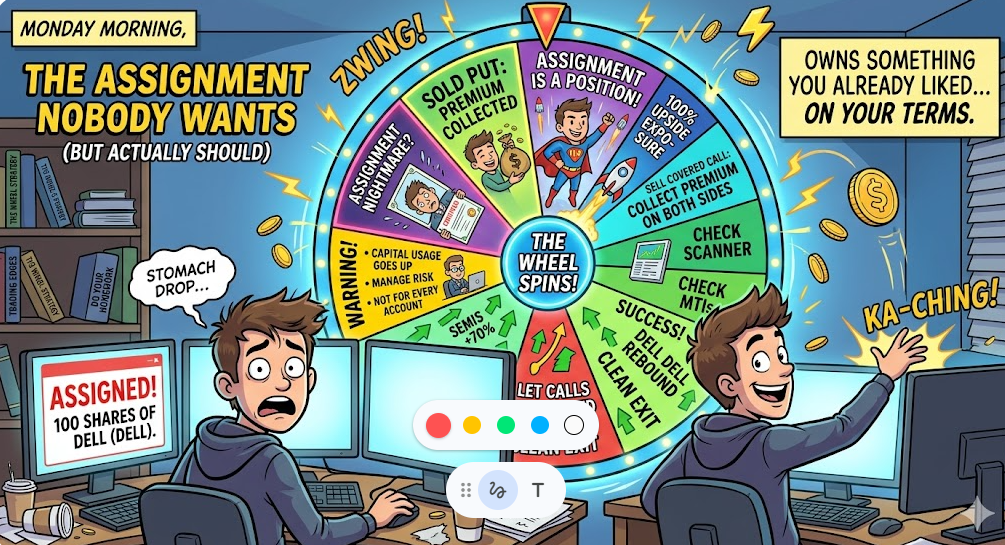
I get it. You sold a put. You wanted the premium. You didn't want 100 shares of Dell (DELL) sitting in your account on a Monday morning.
But here's what I've seen after years of running this strategy across dozens of names: assignment isn't the disaster people think it is. For the right kind of trader, it's where the real edge lives.
Here's the key phrase: right kind of trader.
You only sell puts on names you actually believe in. Stocks tied to real themes. Good stories. Companies with a reason to exist years from now. If you do this on garbage tickers chasing premium, then yes, assignment could be a nightmare. But if you've done your homework, if the MTI (our proprietary Market Trend Indicator that signals when the broader tape is supportive) is green, if the setup is there, getting put the stock is just owning something you already liked at a lower level. With 100 percent upside exposure.
That's not a punishment. That's a position.
Here's the part most people miss. When you're in risk markets, real risk markets where the themes are moving and the upside is genuine, you want the full benefit of that risk. Not a fraction of it. Not just the premium. All of it. The whole ride.
Assignment, when it happens at the right price, is exactly how you get there. You placed the trade with conviction. The market handed you the stock at a level you were already willing to own. Now you're fully in, on your terms.
Think about semiconductors over the last several months. If you ran cash-secured puts (selling a put while holding enough cash to buy the shares if assigned) on any of the major names through the volatility, you would have been assigned. Then those stocks ran 70 percent.
I'm not saying that always happens. But 90 percent of the names I've focused on over the years have eventually come back. The ones that don't are the exceptions. They're real, they happen, and you plan for them with position sizing. They don't define the strategy.
When assignment happens on a name with a valid thesis, that's when the wheel starts spinning. You own the stock. You check the environment. You check the scanner. You check the MTIs. If the setup supports it, you sell calls against the position. You start collecting premium on both sides.
You're no longer a premium seller waiting for expiration. You're building something.
When does the story come back? When the sector turns, when the macro clears, when the thesis that got you in reasserts itself. You let it breathe and ride the wall of fear. Eventually you sell calls and maybe get called away. You're out. Clean. Premium collected on the way down, gains on the way back up.
That's the wheel. And it shines the moment most traders think they've lost.
One important note, because I don't want to make this sound simpler than it is: capital usage goes up when you own shares versus selling a put credit spread (a defined-risk trade where you sell one put and buy another at a lower strike to cap your loss). That's real, and you have to manage it. Not every account is set up for it. Not every risk tolerance supports it. If you're more trader than investor, if you need that capital liquid, the math changes.
But if you're building for income over time, sometimes the best trade is the one that didn't go as planned.
Here for a good time AND a long time,
Hans