

Amazon has run this play four times. Nobody has named it.
Wednesday night they signed a supply deal with Generac and walked away holding warrants on the company. Not a fixed number. The stake grows every time Amazon places another order, up to $8 billion of them.
They did it to Qualcomm last week. Oracle did it to Bloom Energy in April.
Which tells you something about how badly these people need power, and something more useful about where to look next.
Below is how the mechanism works, why the hyperscalers are structuring deals this way instead of just buying the equipment, and the part of this trade that is still underinvested.
Generac issued Amazon a warrant on 1,693,745 shares at $200.93.
About 308,000 of those vested immediately. The rest vest in tranches as Amazon’s payments for backup generators accumulate, up to a ceiling of $8 billion.
Initial deliveries are $2.4 billion across 2027 and 2028.
Now look at the exercise price against where the stock closed that day, which was $175.11.
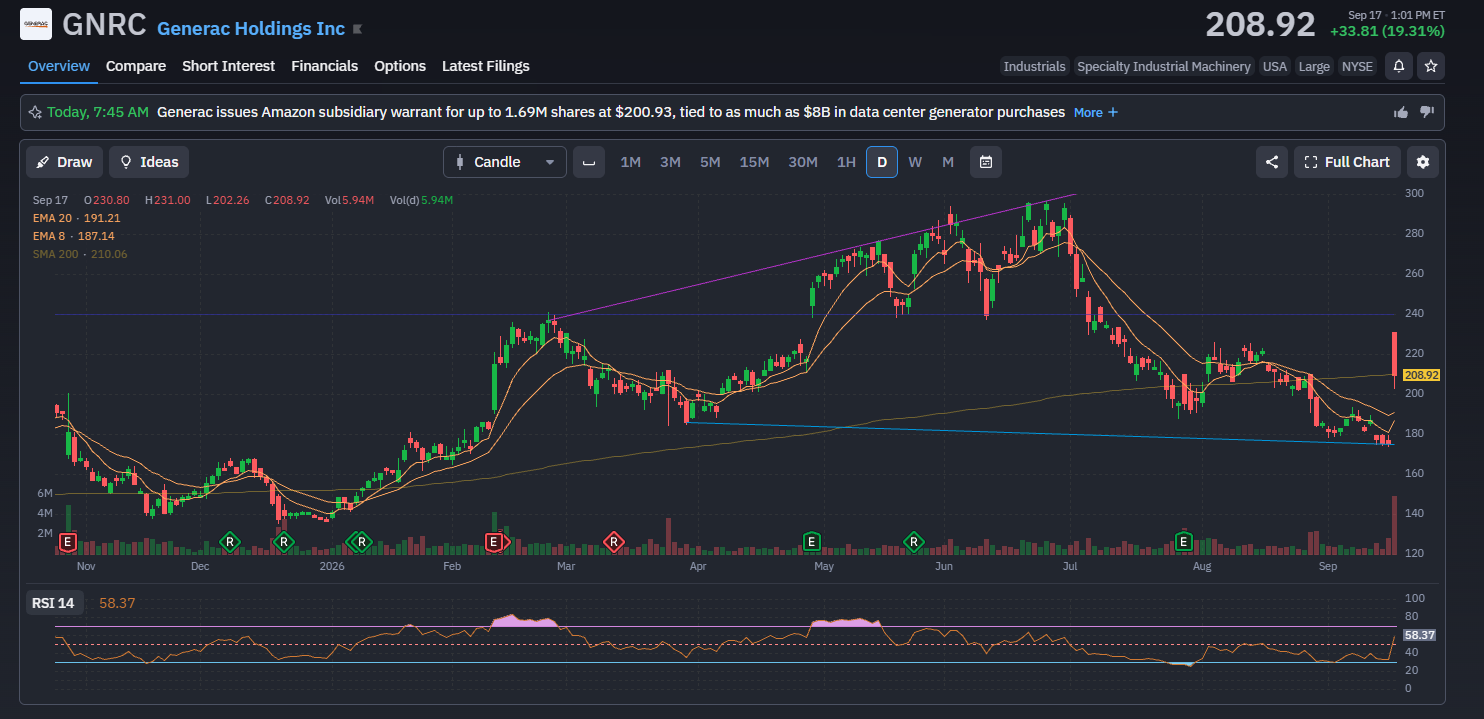
Amazon’s warrants are struck 15% above the market. They make nothing unless Generac keeps climbing.
Read That Again
This is not a customer buying equipment.
This is a customer who has arranged to own a growing piece of the supplier, at a price that only pays off if the supplier does well, with the stake expanding every time the customer places another order.
Amazon is funding the capacity it needs and taking equity in the company building it, and the two things are wired to each other.
That is a better deal than a purchase order.
The Reason They Are Doing It This Way
Amazon has a front seat on how much power is going to be necessary.
They are one of the hyperscalers, meaning the handful of giant cloud companies building AI infrastructure at a scale nobody else can match. They raised capital spending guidance to roughly $220 billion this year, signed a $38 billion cloud deal with OpenAI last November, and opened an $11 billion campus for Anthropic last October.
So they can see the demand curve before anybody else can.
And what they have worked out is that these businesses do not want to be caught short power. The grid cannot supply it fast enough, the regulatory process is slow, and if a data center cannot get electricity it is an expensive building full of idle machines.
They also need a way around the regulatory effort, which is where on-site generation comes in.
It Is Already A Pattern
Last week Qualcomm gave Amazon warrants to acquire up to $4 billion of Qualcomm stock, as part of a deal for custom AI chips. Same structure, different input.
In April, Oracle took a similar position in Bloom Energy.
Amazon has run this play with Astera Labs, with ATSG, with Plug Power and with SpartanNash.
Which is what makes this a blueprint instead of a headline. When the same structure repeats across chips and power and logistics, you are watching a method.
So the question worth asking is who gets the next one.
What I Am Watching
Power generation is the most talked about and underinvested story in this market.
Everybody discusses it. Almost nobody owns it. The money keeps going into the names with AI in the description while the constraint sits one layer down in turbines, reciprocating engines, fuel cells and anything that puts electrons into a building without waiting for a utility.
Here is where my head is on this personally. I live in Texas, and I would not own an electric vehicle here without a full battery backup on the house, because I do not trust the grid.
That is a consumer version of the same calculation Amazon just made at a scale of $8 billion.
Watch which suppliers get a warrant attached to their next big contract. That structure is the tell, because it means the buyer is confident enough in the demand to take equity instead of just taking delivery.
What Would Break It
Start with the obvious objection, which is that Amazon is currently underwater on this position.
Those warrants are struck at $200.93 and the stock closed at $175.11 the day it was announced. I framed that above as a sign of confidence, and a skeptic reads exactly the same fact as Amazon having overpaid for optionality on a company that has to appreciate 15% before any of it means anything.
Both readings are available from the same number.
The second objection is more serious. Amazon’s confidence in Generac is not the market’s confidence in Generac, and Amazon can afford to be wrong about this in a way you cannot. A company spending $220 billion a year on capital does not need every side bet to work.
And the third one is the claim I made about power generation being underinvested. If the story is this obvious, the fair question is what the market is seeing that makes it hesitate.
My answer is regulatory timelines and the fact that none of this revenue shows up for two or three years. The Generac deliveries start in 2027. That is a long time to hold something on a thesis.
Your only option,
Mark Sebastian